
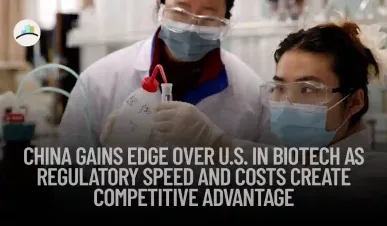
China is rapidly emerging as a global biotech powerhouse, raising concerns among U.S. researchers, policymakers, and investors. With faster regulatory approvals, lower research costs, and strong government backing, China is challenging the U.S.'s long-held dominance in the industry—potentially reshaping the future of pharmaceutical innovation and global health leadership.
China’s Biotech Surge
In recent years, China has strategically positioned itself to take the lead in biotechnology, an industry critical to health security and economic growth. At the center of this rise are policy incentives like the “Made in China 2025” initiative, which prioritizes advanced technologies including biotech.
Chinese clinical trials now begin significantly faster than those in the U.S., according to industry analysts. Cost advantages, with R&D expenditures often 40–60% lower than U.S. firms, make the Chinese biotech ecosystem more agile and risk-tolerant.
"China is investing heavily in capabilities that could define the next era of biotech leadership," said Kevin O’Leary, senior analyst at BioAsia Global. “This isn’t just about catching up—it’s about building a long-term edge.”
Also Read:
Factors Fueling China’s Rise
-
Regulatory Efficiency: China's National Medical Products Administration (NMPA) has shortened approval timelines and adopted more global standards, streamlining clinical research.
-
Talent Repatriation: Many Chinese scientists educated in the U.S. and Europe are returning home, bringing top-tier experience back into China's research institutions and startups.
-
State Support: Billions in state-sponsored investment and access to vast clinical trial populations have made China an attractive hub for biotech firms globally.
Internal pharma reports also cite Beijing’s focus on biosecurity and local production of critical drugs as a strategic response to Western supply chain pressures.
Concerns in the U.S. Market
U.S. officials and investors are taking notice. While the U.S. still leads in overall drug approvals and blockbuster innovation, experts warn that without regulatory reform and stronger public-private collaboration, the gap may narrow further.
Additionally, U.S. biotech startups often face higher capital requirements and longer approval wait times, causing delays in life-saving drug releases.
“Out of five key tech sectors, China has the most immediate opportunity to overtake the U.S. in #biotechnology.” Sounds like a good time to fast track the National Biotechnology Initiative Act of 2025, S.1387 H.R.2756.https://t.co/djGFWfNCCg
— Westportscene (@Westportscene) June 5, 2025
Global Implications
The shift has international ramifications. As Chinese biotech firms expand their footprint in Latin America, Africa, and Southeast Asia, Western pharma companies may lose market share and geopolitical influence. The strategic race to lead in gene editing, mRNA tech, and bio-manufacturing is intensifying.
Looking Ahead
While the U.S. retains substantial advantages in innovation ecosystems, venture capital, and IP protection, China's momentum is undeniable. The next few years will be critical in determining whether biotech leadership remains in the West—or shifts decisively eastward.
For ongoing tracking of biotech market performance and updates, refer to ProCapitas's sector coverage in Healthcare and Pharmaceuticals.
Source
China’s quickly gaining an edge over the US in biotech — CNBC



