
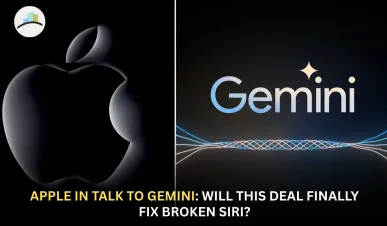
Apple’s Bold Bet on Google Gemini: Can Siri Finally Catch Up?
Apple is reportedly in talks with Google to integrate Gemini AI into a revamped version of Siri. At first glance, this looks like just another corporate partnership. But underneath, it signals something bigger: Apple quietly conceding that its own AI efforts are not yet strong enough to compete with OpenAI’s ChatGPT, Microsoft’s Copilot, or even Google’s own Assistant.
The question isn’t just what Siri becomes next—it’s what Apple risks and gains by tying its future AI strategy to Google.
🚨🚨🚨BREAKING: Apple is planning to integrate Google’s Gemini AI into Apple Intelligence
— NIK (@ns123abc) August 22, 2025
it’s so fucking over for @sama pic.twitter.com/OnEiME4zLP
Why This Matters
For over a decade, Siri has been Apple’s Achilles’ heel. Launched in 2011 with great fanfare, Siri never matched user expectations and has since been overshadowed by Google Assistant and Amazon Alexa. With AI now central to how people interact with devices, Apple can no longer afford for Siri to remain an afterthought.
Partnering with Google’s Gemini is both pragmatic and controversial. Pragmatic because it instantly gives Apple access to a state-of-the-art AI model without waiting years to develop one in-house. Controversial because it risks ceding strategic AI ground to its biggest rival—the same rival that already powers Apple’s default search engine in Safari, a deal worth billions annually.
Apple’s Strategic Dilemma
Apple has long marketed itself as the champion of privacy, building AI features that mostly run on-device. But today’s large language models require massive computing power and scale—something that can’t be delivered entirely on iPhones and iPads.
This creates a fundamental tension:
-
Stick with in-house AI → Risk falling behind competitors.
-
Partner with Google → Risk user trust and regulatory scrutiny.
Apple seems to be choosing a hybrid path: keep user data anonymized and processed on Apple-controlled servers, while licensing Gemini’s intelligence for tasks like reasoning, summarization, and contextual conversations.
The Business & Regulatory Risks
This deal won’t go unnoticed. Regulators in the U.S. and Europe are already scrutinizing Apple and Google for their search-engine exclusivity agreements. Adding AI collaboration raises new antitrust red flags:
-
Market Concentration: Two of the world’s most powerful firms pooling AI resources could reduce competition.
-
Consumer Choice: Will users be able to choose between Apple’s own models, Gemini, or even ChatGPT?
-
Advertising & Data: Even if Apple claims privacy, Google stands to benefit from more AI queries, fueling its data dominance.
Comparison of AI Assistants (2025)
| Feature | Siri (Current) | Google Gemini | ChatGPT (OpenAI) | Microsoft Copilot |
|---|---|---|---|---|
| Conversational Depth | Low | High | Very High | High |
| Integration | Strong (iOS) | Moderate | Moderate | Strong (Windows) |
| Privacy | High | Medium | Medium | Low-Medium |
| Offline Use | Limited | Very Limited | No | No |
| Ecosystem Fit | Apple Devices | Google Apps | Cross-platform | Enterprise/Office |
This table shows the clear gap Apple must close. Siri’s strength lies in deep device integration, but its weakness is lack of intelligence. Gemini offers exactly that—but at the cost of deeper entanglement with Google.
Opinion: Why Apple Had No Choice
Apple’s hesitation to dive fully into generative AI has left it cornered. Its in-house “Apple Intelligence” system is competent but not revolutionary. Meanwhile, everyday users are already relying on ChatGPT or Gemini-powered apps.
This partnership may be less about innovation and more about survival of relevance. If Apple fails to make Siri competitive, it risks iPhones feeling dated—even if the hardware is cutting edge. And in consumer tech, perception matters as much as performance.
Hidden Opportunities
-
Cross-Ecosystem Differentiation: Apple could layer unique features on top of Gemini, making Siri feel distinct rather than a clone of Google Assistant.
-
Hardware Advantage: Apple silicon (M-series, A-series chips) could optimize Gemini inference at speeds Google itself cannot match on Android devices.
-
Enterprise Potential: If Apple can guarantee privacy while using Gemini, it could capture enterprise users who distrust other cloud-first AI providers.
More Articles:
Hidden Risks
-
Dependence on a Rival: Just as Microsoft depends on OpenAI, Apple risks over-reliance on Google for core product features.
-
Brand Identity Clash: Apple = Privacy. Google = Data. Mixing the two could confuse or alienate loyalists.
-
Regulatory Delays: Antitrust probes could slow down or reshape the deal, leaving Apple with an uncertain roadmap.
Final Take
This is more than Apple upgrading Siri—it’s Apple acknowledging that the AI race cannot be won alone. If successful, Siri could transform from a lagging assistant into a true AI companion, finally worthy of the iPhone’s premium image.
But the risks are equally large: privacy erosion, regulatory pushback, and strategic dependence on Google. Apple is betting that it can balance all three—privacy, performance, and politics—without dropping the ball. History suggests that’s easier said than done.



