
Strategic Rationale Behind the Tender Offer
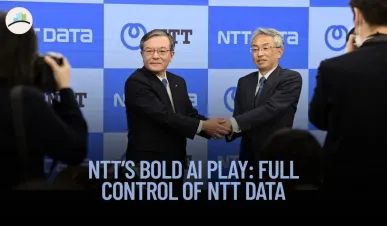
Japanese telecom giant NTT has officially completed its ¥2.37 trillion (approximately $16.4 billion) tender offer for NTT Data, acquiring the remaining 42–43% stake and making the IT services subsidiary wholly owned. The transaction was priced at ¥4,000 per share, a 33–34% premium, making it one of the largest intra-group consolidations in Japan since NTT’s 2020 acquisition of NTT Docomo.
This strategic move tightens NTT's grip over its sprawling technology empire, aligning governance and speeding up decision-making in areas crucial for the next era of digital infrastructure, especially artificial intelligence and enterprise cloud services.
More Articles:
Vertical Integration to Power AI Services
The true value of this deal lies beyond shareholding structure. NTT Data operates over 150 data centers across 20 countries. By integrating these with NTT’s submarine cable network, global telecom infrastructure, and soon-to-scale 6G backbone, the company aims to deliver next-generation AI services with significantly reduced latency.
NTT claims that the integration can lower latency for AI workloads by up to 40%. In practice, this gives them a competitive advantage in rolling out enterprise AI solutions and large-scale AI-as-a-Service platforms that rival global cloud titans such as AWS and Microsoft Azure. The merger enables seamless control over the full stack: from connectivity and compute to analytics and data storage.
Governance Reform and Market Consolidation
This tender offer also satisfies Tokyo Stock Exchange recommendations for corporate simplification, eliminating the inefficiencies of dual-listings and cross-shareholding structures. For Japanese regulators and investors, NTT’s streamlining reflects improved governance and clarity — a strong signal in a market still burdened with complex keiretsu legacy structures.
To fund the deal, NTT secured bridge loans from five Japanese megabanks, with plans to convert them into long-term debt post-acquisition. While the offer attracted attention for its financial scale, it is just as notable for what it reveals about Japan Inc.’s renewed focus on shareholder transparency and global competitiveness.
Risks—Execution, Talent, and Balance Sheet Pressure
Despite strategic alignment, execution risks loom. Analysts highlight internal inefficiencies at NTT Data, including outdated IT systems and limited AI expertise across its workforce. Only a minority of its employees are currently trained in generative AI applications, a critical skill gap in an era of AI transformation.
Additionally, market reaction was muted. NTT’s stock slipped approximately 2% following the announcement, indicating investor concern over deal leverage and long-term capital discipline. Credit ratings agencies may monitor NTT’s debt ratios closely as the integration unfolds.
Nippon Telegraph and Telephone said it has secured enough bids to buy NTT Data, with the deal worth $16.3 billion expected to boost its AI ambitions https://t.co/0PhLkmqhcW
— Bloomberg (@business) June 20, 2025
Long-Term Implications—A Platform for Global AI Infrastructure
In the long term, NTT’s goal is clear: build an integrated, AI-optimized global infrastructure platform. By aligning its telecom, cloud, and IT services into one coherent entity, the company seeks to compete head-on with western hyperscalers. NTT is also investing in clean-energy-powered data centers and next-gen R&D, signaling a multi-decade bet on AI, cybersecurity, and quantum-proof architecture.
Execution will determine whether this vision becomes reality. The successful integration of operations, talent, and customer strategy will shape whether NTT emerges as a global AI infrastructure powerhouse — or just a regional telecom conglomerate with lofty ambitions.
Disclaimer:
This article is intended for informational purposes only and does not constitute investment advice. Procapitas does not provide personalized financial recommendations. Always consult a licensed financial advisor before making investment decisions. Information is based on publicly available sources as of June 2025 and Procapitas’ independent research and analysis.



