
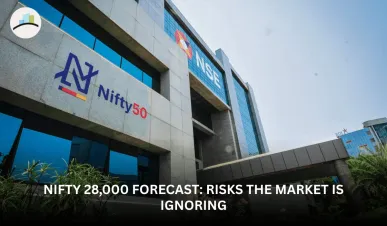
Nifty at 28,000? What the Market Isn’t Pricing In Yet
India’s benchmark Nifty 50 has shown remarkable resilience, and some fund managers are now forecasting a sharp move toward the 28,000 mark—if corporate earnings rise in the mid-teens over the next 12–18 months. But this bullish narrative may be overlooking risks and economic fault lines that could reshape the market's trajectory.
The Profit Engine Behind the 28,000 Forecast
The expectation of Nifty 50 reaching 28,000 hinges on sustained earnings growth—driven by multiple macro and sectoral tailwinds:
-
Infrastructure and Capital Goods Upswing: Government capex and PLI schemes are boosting order books in infra-linked sectors.
-
Consumer Recovery in Tier 2 & 3: Improving rural liquidity and a likely normal monsoon are raising hopes of a broad-based consumption recovery.
-
Banking Sector Balance Sheet Strength: Lower NPAs and credit growth momentum could sustain profitability in BFSI, which makes up a large share of Nifty 50 earnings.
-
Export Resilience in IT and Pharma: Despite global softness, demand for tech services and essential drugs remains steady.
These sectors collectively support the mid-teens earnings growth assumption necessary to push the index to 28,000 by FY26.
What Is Being Underestimated?
1. Global Growth Headwinds
The bullish forecast relies heavily on domestic earnings, but global demand contraction—especially from Europe and China—could dampen export-heavy sectors like IT, metals, and chemicals.
2. Valuation Fragility
At current levels, Nifty is already trading at a forward P/E of around 20–21x. With VIX at historically low levels, markets are potentially underpricing geopolitical or inflationary shocks.
3. Fragile Rate Cut Expectations
The RBI is expected to cut rates in early 2025, but if global inflation remains sticky or oil prices spike, any delay could rattle debt-laden sectors and impact corporate earnings projections.
Political and Policy Implications
With the general elections approaching, political uncertainty could impact investor sentiment. While pre-election populist spending may temporarily lift consumption, it could also create fiscal pressures that limit post-election stimulus. This raises concerns about how sustainable the current growth momentum really is.
Unseen Sector Opportunities
-
Gold Finance NBFCs: As interest rate cycles turn, well-capitalized NBFCs focused on secured lending (e.g., gold loans) may offer stable returns.
-
Mid-cap Industrials: Companies with healthy order books and clean balance sheets could benefit from increased private capex.
-
Two-wheeler and Tractor OEMs: Early signs of rural demand recovery suggest a positive cycle in low-ticket consumer durables.
What History Suggests
India’s market behavior in 2003–07 and 2014–15 shows that mid-teens earnings growth can support multi-year rallies. However, both periods were eventually disrupted by global shocks or internal macro tightening. A similar pattern today—especially in an election year—could test the durability of the rally.
Why This Matters
The 28,000 Nifty target is more than just a number. It reflects investor faith in the India growth story—but markets may be ignoring global fragility, sector-specific challenges, and monetary tightening risks. Investors and policymakers alike must tread carefully, ensuring that optimism doesn’t turn into overreach.
Disclaimer:
This article is intended for informational purposes only and does not constitute investment advice. Procapitas does not provide personalized financial recommendations. Always consult a licensed financial advisor before making investment decisions. Information is based on publicly available sources as of June 2025 and Procapitas’ independent research and analysis.



