
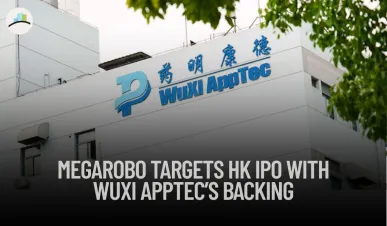
China's Robotics Bet Reaches the Capital Markets
Megarobo Technologies, a fast-rising Chinese robotics and AI startup, backed by pharmaceutical giant Wuxi AppTec, is reportedly preparing for an Initial Public Offering (IPO) in Hong Kong. While details of the deal are yet to be formally disclosed, early signals suggest that the company could file as soon as late 2025, as China's capital markets prioritize innovation-driven listings to reassert economic leadership amid global geopolitical tension.
Megarobo operates in the intersection of intelligent automation, AI-based robotics, and life sciences technology—a convergence that aligns with China's broader state-backed strategy to replace labor-intensive sectors with high-efficiency robotic infrastructure. The move to go public now, amid a recovering IPO market in Hong Kong, signals a confidence in both demand-side capital and long-term automation trends.
More Articles:
How Megarobo Differentiates in a Crowded Robotics Sector
Unlike traditional robotics companies, Megarobo has carved a niche by applying robotic process automation (RPA) and AI vision systems across several verticals—healthcare laboratories, smart manufacturing, agriculture, and biotech logistics. The company’s platforms are not just programmable mechanical arms; they operate with intelligent sensing and adaptive movement—capabilities that enable precision in complex environments like lab sample testing or automated organoid cultures.
Its flagship offerings include lab automation solutions that replace manual sample transfers with fully programmable, sterile robotic workflows—reducing human error and biohazard exposure. In sectors such as agriculture, Megarobo’s autonomous platforms use real-time terrain mapping and crop analytics to perform seeding, fertilizing, and harvesting tasks with minimal human oversight.
This “platform-level intelligence,” not just machinery, positions Megarobo as a verticalized AI automation player, setting it apart from commodity robotics manufacturers.
The Strategic Value of Wuxi AppTec’s Backing
Wuxi AppTec, a global leader in drug discovery, development, and manufacturing services, has quietly emerged as a deep-pocketed backer of AI and biotech crossover firms. Its support of Megarobo is not purely financial—it brings access to Wuxi’s R&D infrastructure, cleanroom-grade manufacturing capabilities, and regulatory pathways across North America, Europe, and China.
This backing offers Megarobo a real-world testing ground, especially in life sciences and med-tech robotics, where lab automation is a bottleneck for scaling clinical diagnostics. Wuxi’s global compliance expertise could also help Megarobo navigate foreign IP regimes, GMP manufacturing standards, and clinical-grade data integration.
Investors should read this IPO not just as a capital event, but as the externalization of Wuxi’s longer-term vision: to become a multi-sector tech-holding powerhouse—akin to Japan’s SoftBank, but with stronger industrial execution.
Hong Kong’s Role: Financial Gateway, Political Hedge
The selection of Hong Kong as the IPO venue is both strategic and symbolic. While mainland exchanges like STAR Market offer deep domestic capital, Hong Kong allows Megarobo access to international liquidity and dollar-denominated investment—crucial for a company with global IP ambitions.
At the same time, the Hong Kong listing buffers Megarobo from U.S. scrutiny, where China-based firms face increasing regulatory risk, including potential delisting, tech transfer restrictions, and investment bans. As U.S.-China decoupling deepens, Hong Kong remains one of the few viable compromise geographies for companies with global vision and Chinese origin.
IPO Outlook: Market Conditions and Competitive Landscape
Hong Kong’s IPO pipeline has rebounded in 2025 following two tepid years. Megarobo is likely to attract institutional interest, particularly from funds seeking exposure to high-growth, hard-tech sectors not easily accessible via U.S. markets.
That said, valuation multiples will hinge on how Megarobo positions its growth narrative—particularly how it balances SaaS-style robotics platforms with hardware margins. Comparables like UBTech and DJI (private) could serve as valuation anchors, but investors will closely scrutinize revenue concentration, after-sales service models, and global IP protection strategies.
The competition is growing too. Startups in Singapore, Japan, and Germany are also pushing advanced robotics into life sciences and precision agriculture. Megarobo's long-term moat may depend on how fast it can localize outside China while maintaining technical leadership and cost efficiency.
Disclaimer:
This article is intended for informational purposes only and does not constitute investment advice. Procapitas does not provide personalized financial recommendations. Always consult a licensed financial advisor before making investment decisions. Information is based on publicly available sources as of June 2025 and Procapitas’ independent research and analysis.



