
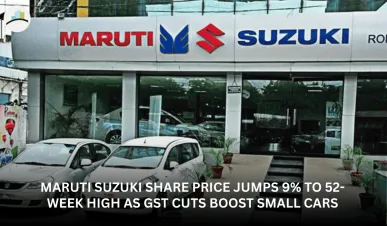
Small Cars Back in the Spotlight
Maruti Suzuki’s stock surged nearly 9% to a 52-week high after the government’s Goods and Services Tax (GST) reduction on smaller vehicles reignited investor optimism. The tax cut, aimed at making compact cars more affordable, is expected to boost sales volumes in a segment where Maruti is the undisputed leader. For investors, the move signals a short-term demand revival and potentially a structural shift in India’s auto consumption patterns.
📈 Top Gainers – Large Cap | Aug 18, 2025
— Shivam singh (@thisismrveer) August 18, 2025
🟢 Maruti Suzuki – ₹14,068 ▲ +8.75%
🟢 Hyundai Motor India – ₹2,423.40 ▲ +8.15%
🟢 TVS Motor – ₹3,219.70 ▲ +6.60%
🟢 Hero MotoCorp – ₹4,984 ▲ +5.86%#TopGainers #Nifty100 #StockMarket #Sensex #MarketUpdate pic.twitter.com/8vCKcGDOLh
Why the GST Cut Matters Now
The timing is critical. India’s auto sector has been under pressure from slowing rural demand, rising input costs, and the consumer shift toward SUVs. Small cars, once the backbone of India’s passenger vehicle market, have lost share to higher-margin SUVs over the past five years. By cutting GST, the government is trying to revive mass-market affordability, particularly for first-time buyers. This could correct the imbalance in the auto sector and reduce the risk of a K-shaped recovery where only premium buyers drive demand.
Investor Sentiment and Market Dynamics
The market reaction reflects expectations of higher sales volumes for Maruti’s bread-and-butter models such as Alto, WagonR, and Swift. Analysts suggest that every 1% improvement in small-car penetration could add significantly to Maruti’s top line, given its nearly 40% market share. The surge also lifted other auto stocks, showing how policy decisions ripple across the industry. However, the real test lies in sustaining demand beyond the initial GST-driven boost.
Lessons From the Past
India has seen similar tax-driven demand recoveries before. In 2008–09, during the global financial crisis, excise duty cuts on cars temporarily revived demand, helping the sector avoid a deeper slump. However, once the incentives rolled back, sales growth slowed again. Investors and policymakers alike should be cautious not to view the GST cut as a permanent demand driver—it works best when combined with income growth, easy financing, and consumer confidence.
Opportunities and Risks Ahead
For Maruti, the opportunity lies in reclaiming dominance in the entry-level market, where its leadership has recently been challenged. A successful revival of small-car sales could improve capacity utilization and stabilize margins despite high competition in the SUV space. On the flip side, risks include rising fuel prices, potential supply-chain constraints, and the possibility that urban aspirational buyers continue to prefer SUVs despite tax cuts.
Also read on Procapitas
What Comes Next?
The government may extend similar measures to other sectors if GST-driven demand revival proves successful. For automakers, the focus will shift to balancing product portfolios—offering affordable cars while investing in EVs and SUVs. Investors should watch for September quarter sales data to see whether this policy translates into sustained momentum or fades as a short-lived rally.
Disclaimer:
This article is for informational purposes only and does not constitute investment advice or a recommendation to buy or sell any securities. Procapitas does not provide personalized financial advice. All investment decisions should be made in consultation with a licensed financial advisor. The information presented is based on publicly available sources and Procapitas’ independent research and analysis, which are believed to be reliable but are not guaranteed for accuracy or completeness.



