
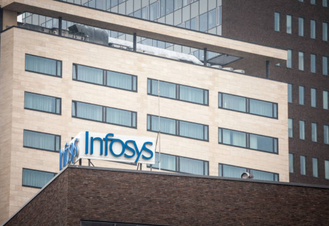
Despite Infosys' underwhelming March quarter results, international brokerages such as Morgan Stanley and Jefferies remain confident about the IT services firm's prospects for expansion. The company's FY23 annual report, which states the company expects digital to continue driving IT spending in the longer term even as cost-efficiency programs are driving spending in the short term, is the source of the optimism.
The stock is rated Overweight by Morgan Stanley, and its price objective is Rs 1,475. Jeffries has a Buy rating and a Rs 1,570 price target.
Infosys anticipates increased demand as a result of investments in immersive technologies, cloud computing, generative artificial intelligence, cybersecurity, and IoT. According to Jefferies, Infosys' investments in digital technology put it in a strong position to benefit from these possibilities.
Because fewer new hires are hired each year, the company's personnel pyramid has stayed stable. Margin pressure came from mid-level personnel, whose high attrition rate was likely to continue.
Nevertheless, Infosys' investment return on equity increased by about 300 basis points to 32% in FY23. According to Jefferies, this was driven by a higher asset turnover rate and a decrease in balance sheet cash.
Free cash flow conversions declined year over year, but it has now returned to levels before Covid, the report said.
Infosys reported a 7.8 percent year-over-year increase in its overall net profit at Rs 6,128 crore in the fourth quarter, while sales increased by 16 percent YoY to Rs 37,441 crore. Both figures fell short of street projections.
The company anticipates a sales increase between 4 to 7 percent in FY24. According to The Street, the figure should be around 6 to 8 percent when expressed in constant currency. 29 "buy" calls, 9 "hold" calls, and an equal number of "sell" calls are available on the stock.
At 11:45 a.m., Infosys shares were trading on the NSE for Rs 1,285.10, up 0.48 percent from the previous close. The American company EPAM reduced its sales forecast in the middle of the June quarter, which caused the shares to decline on June 6.



