
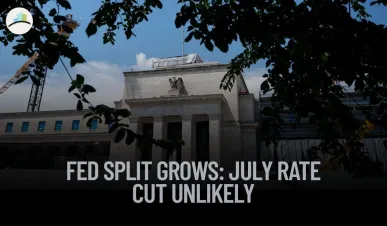
As the U.S. economy grapples with persistent inflation concerns and signs of labor market fatigue, an internal policy divide is emerging at the Federal Reserve. Several top Fed officials are voicing hesitation over a potential interest rate cut in July, citing the need for more data before adjusting course. While some governors remain open to easing if inflation continues to soften, the broader consensus across the Federal Open Market Committee (FOMC) leans toward caution.
This divergence reflects not just differing interpretations of economic signals but also varying levels of risk tolerance. On one end, officials like Fed Chair Jerome Powell and regional presidents such as John Williams (New York) and Mary Daly (San Francisco) emphasize patience. On the other, voices like Governors Michelle Bowman and Christopher Waller suggest the data may justify more immediate action to support labor resilience.
More Articles:
Powell's "Wait-for-Data" Playbook
Chair Powell has repeatedly stressed that the Fed is not in a rush to change course. With inflation still hovering just above the Fed’s 2% target, Powell has indicated a willingness to wait until there is more evidence that inflation is on a clear and sustained downward path. His recent remarks suggest that he sees current policy as sufficiently restrictive and that an early rate cut could risk undoing hard-earned progress on inflation control.
Supporting Powell’s view are economic risks tied to potential trade tensions and new tariffs. Policymakers are particularly wary that any geopolitical instability or supply chain disruptions could reignite inflation in ways not yet visible in core consumer data.
The Case for a July Cut: Doves Push Back
Despite this caution, not all Fed voices are aligned. Governors Bowman and Waller have presented a more dovish stance, arguing that inflation appears to be under control and that some signs of labor market softening are emerging. Their concern is that holding rates too high for too long could tip the economy into an avoidable slowdown, particularly at a time when hiring has moderated and wage growth is cooling.
These policymakers believe that a preemptive cut in July could act as insurance—supporting consumer demand and employment without triggering inflationary pressures. However, this perspective remains in the minority for now, especially as broader inflation expectations remain above target for the next several quarters.
Inflation and Employment: A Tense Balance
Recent data offers a mixed picture. April’s personal consumption expenditures (PCE) inflation, the Fed’s preferred gauge, came in at 2.1%. While that’s slightly above target, it represents a meaningful decline from the levels seen in 2022 and early 2023. Meanwhile, unemployment claims have begun to creep upward, and job openings are declining, suggesting some slack is developing in the labor market.
Still, most officials are not convinced that this justifies immediate easing. Their preference is to wait through the summer, using fall meetings to reassess whether inflation is truly anchored and whether labor softening is temporary or structural.
🇺🇸 Majority of #Fed Officials Leaning Against July Interest-Rate Cut - Bloomberghttps://t.co/nMtGA25Aet pic.twitter.com/KichUo2hXj
— Christophe Barraud🛢🐳 (@C_Barraud) June 27, 2025
Market Expectations and Policy Impact
The divide within the Fed is now beginning to shape investor expectations. Market-based probabilities for a July cut have fallen sharply, now sitting below 25%. Traders and analysts increasingly view the September meeting as a more likely window for the first rate reduction in 2025.
If the Fed delays cuts until the fall, higher borrowing costs will persist for consumers and businesses. Mortgage rates, auto loans, and credit card interest rates will remain elevated, potentially slowing household spending and business investment. Meanwhile, any signs of prolonged policy disagreement could fuel market volatility, especially in the bond market, where Treasury yields have already begun adjusting to a “higher for longer” rate environment.
Disclaimer:
This article is intended for informational purposes only and does not constitute investment advice. Procapitas does not provide personalized financial recommendations. Always consult a licensed financial advisor before making investment decisions. Information is based on publicly available sources as of June 2025 and Procapitas’ independent research and analysis.



