
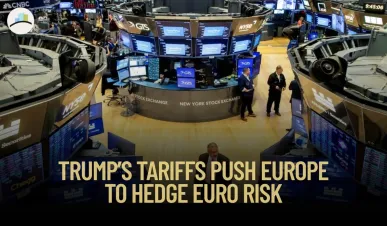
As former U.S. President Donald Trump ramps up rhetoric around renewed trade tariffs, European companies are bracing for impact. In anticipation of potential currency shocks, corporates and institutional investors across the continent are increasingly leaning into foreign-exchange (FX) options to hedge exposure to the volatile euro-dollar pairing.
This shift marks a significant evolution in Europe’s risk management strategy—away from conventional forward contracts toward more sophisticated hedging instruments that offer flexibility in an uncertain geopolitical and monetary environment.
More Articles:
Trade Tensions Push Volatility Risk Front and Center
Trump’s renewed push for tariffs on Chinese and European goods, set to potentially kick off with a July 9 deadline, is already causing currency markets to jitter. The euro, which has appreciated around 14% year-to-date, has become a focal point of risk for European exporters.
Companies fear two major scenarios: a further strengthening of the euro, which would erode export competitiveness, or a sudden reversal in case of retaliatory measures that could unsettle import pricing. This asymmetric risk profile has made vanilla forward hedging less attractive and sparked a surge in demand for FX options—especially structured strategies like collars and risk reversals.
FX Options Offer Strategic Hedging Without Sacrificing Upside
FX options offer corporates more nuanced protection. Unlike forwards, which commit a company to a fixed exchange rate, options provide the right—but not the obligation—to exchange currency at a preset level.
For European treasurers, this is critical. A collar strategy, for example, allows companies to limit downside exposure to a weakening euro while preserving some upside potential should the currency strengthen. This flexibility is especially valuable in an environment where both macroeconomic indicators and political outcomes remain in flux.
As a result, FX desks in multinational corporations are rebalancing their hedging books—diversifying instruments and durations to create a more dynamic currency defense mechanism.
ECB Messaging Adds Complexity to Currency Forecasting
The European Central Bank (ECB) has recently signaled caution around further euro appreciation. While policymakers may tolerate the euro rising up to a certain level—likely near $1.20—there is growing concern that any further strength could stifle inflation and hurt export-driven sectors.
This creates a dual challenge for corporates: they must prepare for both market-driven and central bank–influenced volatility. ECB policy guidance is now being modeled directly into hedging strategies, with many companies adjusting their strike levels and timeframes in response to monetary policy signals.
This reflects a deeper integration of macroeconomic forecasting into treasury operations, marking a significant maturity in financial risk governance among European firms.
From Passive Hedges to Active Risk Management
Traditionally, many European corporates relied on basic FX forwards to hedge predictable exposures. However, with trade dynamics now more politically driven and less linear, companies are shifting toward active risk management models.
Mid-sized exporters in Germany, France, and the Netherlands are adopting multi-layered FX strategies. These include tactical use of short-dated options around known geopolitical triggers—such as tariff deadlines—as well as strategic long-term coverage with vanilla calls or protective puts.
Treasury departments are also working more closely with external advisers and banks to optimize cost vs. protection, using advanced analytics to simulate potential FX paths under various macro and geopolitical scenarios.
Systemic Implications: A New Hedging Culture in the Eurozone
This move toward options-based currency hedging could have long-term consequences for how the euro trades globally. As more players hedge asymmetrically, the pricing and liquidity dynamics of the EUR/USD options market will shift.
Market makers may adjust pricing models to account for increased demand in specific strike zones, particularly in the 1.15–1.20 range. Meanwhile, option volumes may dampen short-term volatility by absorbing excess market pressure, acting as an informal volatility buffer.
Strategically, the rise of structured hedging in Europe signals a more proactive, adaptive financial mindset—an institutional evolution prompted by geopolitical flux and economic uncertainty.
Trump Trade War Fuels Use of Currency Options as Hedge in Europe https://t.co/y6FhhQ0vrW
— Investor Central Club + STAX AI (@ICtradeideas) July 3, 2025
Summary
Trump’s revived trade war rhetoric has reignited fears of currency volatility across Europe. In response, European corporations are increasingly turning to FX options as a dynamic, flexible tool to manage risk. This shift away from rigid forward contracts toward structured options reflects both growing market complexity and the need for tailored hedging. At the intersection of policy, politics, and financial strategy, Europe’s FX hedging playbook is being rewritten—option by option.
Disclaimer:
This article is intended for informational purposes only and does not constitute investment advice. Procapitas does not provide personalized financial recommendations. Always consult a licensed financial advisor before making investment decisions. Information is based on publicly available sources as of June 2025 and Procapitas’ independent research and analysis.



