
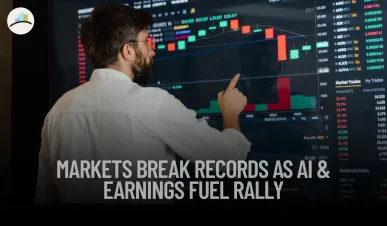
The U.S. stock market surged to new highs on July 17, 2025, despite political uncertainty and renewed tariff rhetoric from the Trump campaign. The Dow Jones Industrial Average rose by approximately 0.5% to close at 44,484.49. The S&P 500 climbed by 0.5% to reach 6,297.36, and the Nasdaq Composite advanced by 0.7% to 20,884.27. This bullish performance was underpinned by robust corporate earnings, surprisingly strong consumer data, and steady jobless claims that reinforced economic resilience.
Retail sales rebounded by 0.6% in June, exceeding expectations and signaling continued consumer strength. Meanwhile, weekly jobless claims dropped to 221,000, marking one of the lowest levels this quarter. Together, these indicators suggest that U.S. economic momentum remains solid, despite global headwinds and political uncertainties.
More Articles:
Corporate earnings, particularly from blue-chip and technology companies, played a pivotal role in lifting investor sentiment. PepsiCo reported better-than-expected revenue and earnings, driving its stock up by over 7%. Taiwan Semiconductor Manufacturing Company (TSMC) announced record-breaking profits and raised its full-year outlook by nearly 30%, bolstering investor confidence in the tech sector. United Airlines also exceeded Wall Street forecasts, sending its shares higher by nearly 3%.
Despite fresh political noise surrounding potential tariffs and threats to Federal Reserve independence, markets remained unfazed. Fed officials reassured investors with comments indicating a patient and data-dependent approach to interest rates, further supporting bullish sentiment.
Deep-Dive: What’s Really Driving the Market Surge?
Corporate Earnings are Defying Gravity
One of the most compelling narratives this earnings season is the strength of corporate performance across sectors. PepsiCo’s earnings underscore that major consumer brands are not only weathering inflation but are also expanding margins through pricing power and operational efficiency. Similarly, United Airlines continues to benefit from robust travel demand and improved cost structures.
TSMC’s record earnings and upward revision of its annual forecast highlight the accelerating demand for high-performance semiconductors, particularly those used in artificial intelligence (AI) applications. As AI adoption spreads across industries, chipmakers with advanced manufacturing capabilities are seeing disproportionate benefits. This trend is especially evident in how semiconductor stocks are outperforming the broader market, led by giants like Nvidia and TSMC.
AI is Reshaping Market Leadership
The most transformational driver of equity markets in 2025 is arguably artificial intelligence. Nvidia's market capitalization recently exceeded $4 trillion, driven by overwhelming demand for its GH200 AI chips. These chips are being deployed in a wide range of advanced computing applications, including new-generation supercomputers in the United Kingdom.
What makes the AI rally distinct is its impact on both micro and macro levels. At the micro level, firms like TSMC and Nvidia are delivering tangible earnings growth and forward guidance improvements. At the macro level, AI innovation is contributing to productivity gains that could soften the blow of future interest rate hikes or global economic slowdowns.
Labor Market and Consumer Spending are Holding Strong
The combination of resilient consumer spending and a strong labor market is providing a backstop for the economy—and by extension, the market. June’s retail sales growth of 0.6% signals that consumers are still willing to spend, especially in discretionary categories. Jobless claims dropping to 221,000 suggests ongoing tightness in the labor market, which supports income stability and consumer confidence.
This data diminishes the likelihood of a near-term recession and strengthens the Federal Reserve’s case for maintaining its current interest rate stance. Investors are increasingly pricing in a “soft landing” scenario, where inflation cools without a significant contraction in growth.
Market Breadth is Expanding
A notable aspect of this rally is its breadth. The Russell 2000, which tracks small-cap stocks, rose by 1.2%—outpacing the larger indices. Gains were also recorded in cyclical sectors like industrials and transportation, with GE Aerospace and United Airlines showing strong momentum.
This expansion beyond mega-cap tech indicates a healthier and more sustainable rally. Rather than being narrowly concentrated in a handful of tech names, the market is seeing participation from a wider array of sectors, including consumer goods, energy, and transportation.
Political Risk is Being Discounted—For Now
While Donald Trump’s recent remarks about reinstating blanket tariffs and possibly firing Federal Reserve Chair Jerome Powell have raised concerns, the market reaction has been muted. Investors appear to be treating these as campaign rhetoric rather than imminent policy shifts.
This suggests that political noise is being filtered through the lens of economic data. As long as corporate earnings and macro indicators remain strong, the market is likely to discount short-term political turbulence.
Disclaimer:
This article is intended for informational purposes only and does not constitute investment advice. Procapitas does not provide personalized financial recommendations. Always consult a licensed financial advisor before making investment decisions. Information is based on publicly available sources as of June 2025 and Procapitas’ independent research and analysis.



