
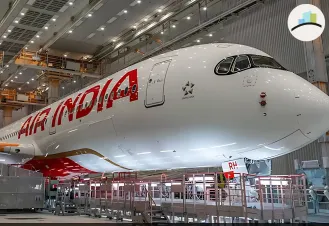
Air India, under the leadership of the Tata Group since January 2022, has experienced significant growth. The airline’s revenues have surged nearly tenfold, reaching close to USD 10 billion, compared to less than USD 1 billion in FY20. The Air India Group now operates 1,168 daily flights, including 313 international services, with 244 short-haul and 69 long-haul flights.
Seeking to capitalize on “huge growth opportunities,” Air India plans to expand its premium offerings. This includes increasing the number of premium economy and business class seats across its fleet. The airline also aims to realign flight timings to better capture connecting traffic and optimize its network to deploy the most efficient capacity. Nipun Aggarwal, Air India’s Chief Commercial Officer, noted that both premium economy and business class segments have seen a significant rise in load factors, reflecting growing demand. He emphasized that Air India is particularly focused on the premium segment, with revenue growth in the front cabin having nearly doubled, while back cabin revenue has also seen a substantial increase.
As part of this expansion, Air India will retrofit its wide-body aircraft to add more premium seats, nearly doubling the number of business and premium economy seats. Additionally, the airline plans to introduce first class seats in its wide-body A350-1000 aircraft, following the example of its Boeing 777 aircraft, which already feature first class. The retrofitting of narrow-body aircraft has already begun, and wide-body aircraft retrofitting is set to commence later in the year. By mid-2025, Air India aims to offer 53,000 premium seats on metro-to-metro routes with new or upgraded products.
Aggarwal further explained that the airline is rationalizing its network and realigning flight schedules to improve connectivity. For instance, overlapping domestic routes have been reduced from 29 to 20, and international overlaps have dropped from 23 to 6. This restructuring is aimed at optimizing capacity deployment across Air India and its low-cost subsidiary, Air India Express. In particular, Air India is focusing on reducing average connecting times from domestic to international flights, which has already been cut from 6.5 hours to 3.5 hours, with further improvements planned.
One of the key strategies for Air India’s growth is enhancing international-to-international (I2I) connectivity, particularly between regions like Southeast Asia, Europe, and North America. Aggarwal noted that I2I traffic currently represents 10% of the airline’s total traffic, and the goal is to increase this share to 15-20% over the next three years. The airline has been working to better align flight timings for smoother connections, including between European destinations and Australia, as well as Southeast Asia and Europe.
With its 135 narrow-body planes and 67 wide-body aircraft, Air India is focused on three major hubs: Delhi, Mumbai, and Bengaluru. These hubs will serve as primary points for international connections, while Air India Express will handle other regional markets. According to Aggarwal, the growth potential for Air India is immense, and the airline has now acquired the necessary size and scale to become a significant player in the aviation industry. With a fleet of around 300 aircraft, including those from Vistara, which was merged into Air India, and AIX Connect, integrated into Air India Express, the airline is well-positioned for future growth.



