
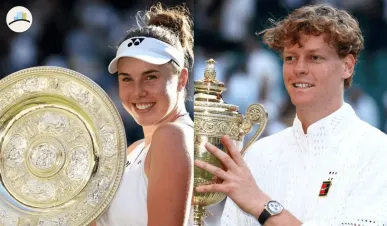
The Wimbledon final was supposed to answer one of the biggest questions in men's tennis:
Has Jannik Sinner truly become the player to beat?
After nearly four hours of intense competition on Centre Court, the answer became clearer.
The Italian world No. 1 defeated Alexander Zverev in a dramatic four-set battle to successfully defend his Wimbledon men's singles title and add another chapter to his rapidly growing legacy.
Sinner's victory was not straightforward.
He had to survive a huge challenge from Zverev, losing the opening set before changing the momentum of the match and eventually winning 6-7(7), 7-6(2), 6-3, 6-4.
For Sinner, it was another statement.
For Zverev, it was another reminder of how difficult it is to overcome the very best players on the biggest stages.
A Wimbledon Final That Defined the New Era of Tennis
For years, men's tennis was dominated by the legendary rivalry between Roger Federer, Rafael Nadal and Novak Djokovic.
But as that era slowly changed, a new generation began searching for its own identity.
Jannik Sinner has emerged as one of the strongest candidates to lead that next chapter.
At only 24 years old, the Italian has already built a Grand Slam collection that places him among the elite players of his generation.
His Wimbledon 2026 victory became his fifth major championship, adding another milestone to a career that has accelerated at remarkable speed.
How Sinner Turned Around the Wimbledon Final
The opening set showed exactly why Alexander Zverev remains one of the most dangerous players in tennis.
The German matched Sinner's power from the baseline and pushed the defending champion into a tense tiebreak.
Zverev eventually claimed the first set 7-6 after holding his nerve during the crucial moments.
For a moment, it appeared that Sinner could be facing one of his toughest Grand Slam finals.
But champions often separate themselves through their ability to respond.
Sinner returned with greater aggression in the second set.
His movement improved, his groundstrokes became more consistent and he dominated the second-set tiebreak to level the match.
That moment changed everything.
The Turning Point: Sinner’s Mental Strength
The biggest difference between the two players was not only technical.
It was mental.
After losing the first set, Sinner remained calm and refused to allow frustration to affect his game.
That composure has become one of his biggest strengths.
Instead of chasing winners too early, he trusted his movement, waited for opportunities and slowly broke down Zverev’s resistance.
The third and fourth sets reflected that change.
Sinner began controlling longer rallies and forcing Zverev into uncomfortable positions.
Alexander Zverev’s Wimbledon Dream Falls Short
For Alexander Zverev, this final represented another major opportunity.
The German entered Wimbledon with enormous confidence after winning his first Grand Slam title at the French Open.
A Wimbledon trophy would have placed him among the rare players capable of winning consecutive majors on different surfaces.
Instead, he found himself facing the player currently setting the standard in men's tennis.
Despite the defeat, reaching the Wimbledon final represented a significant achievement in Zverev's career.
He showed that he belongs among the sport's elite and remains one of the biggest threats to Sinner's dominance.
Sinner vs Zverev: A Rivalry Beginning to Take Shape
The Wimbledon final added another chapter to the growing rivalry between Sinner and Zverev.
Their matches represent a clash of styles:
Jannik Sinner
- Explosive timing
- Incredible movement
- Powerful baseline game
- Calm under pressure
Alexander Zverev
- Elite serving
- Heavy groundstrokes
- Defensive ability
- Physical endurance
As Federer-Nadal-Djokovic moved into history, tennis needed new rivalries.
Sinner and Zverev could become part of that next generation.
How Many Grand Slams Does Jannik Sinner Have?
After winning Wimbledon 2026, Sinner now owns five Grand Slam singles titles.
His major victories include:
- Australian Open 2024
- US Open 2024
- Australian Open 2025
- Wimbledon 2025
- Wimbledon 2026
At 24 years old, his achievements have already placed him among the most successful young players in modern tennis history.
Why Sinner Is Becoming Tennis’ New Superstar
Sinner's rise has been different from many previous champions.
He is not built around emotional intensity or constant aggression.
Instead, his success comes from:
- Discipline
- Tactical intelligence
- Physical improvement
- Consistency
His ability to remain composed during pressure moments has become one of his biggest advantages.
The Wimbledon final against Zverev showed exactly why.
Wimbledon 2026 Final: Key Moments
Zverev wins the opening set
The German immediately showed he was not intimidated by the defending champion.
Sinner responds in the second set
The Italian changed the rhythm and dominated the tiebreak.
Sinner takes control
His consistency began overwhelming Zverev during the third and fourth sets.
History secured
Sinner lifted his second consecutive Wimbledon trophy.
MORE ARTICLES:
What Is Next for Jannik Sinner?
The biggest question now is not whether Sinner can win Grand Slams.
He already has.
The question is how many he can collect.
With his age, fitness and current level of consistency, Sinner has the opportunity to build one of the most impressive careers in tennis history.
However, challenges remain.
Carlos Alcaraz, Alexander Zverev and other rising stars will continue pushing him.
The next era of men's tennis may be defined by how long Sinner can stay ahead.
Final Verdict
The Wimbledon 2026 final was more than another championship match.
It was a sign of tennis entering a new era.
Alexander Zverev delivered a huge challenge, but Jannik Sinner once again showed the qualities of a champion.
His ability to recover from setbacks, handle pressure and perform on the biggest stage has transformed him from a rising star into the face of modern men's tennis.
Wimbledon now belongs to Sinner.
The bigger question is:
How long can anyone stop him?



