
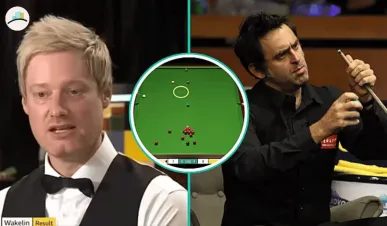
Ronnie O'Sullivan's Chalk Is Legal, But the Science Behind Why It Alters the Table Explains Why Robertson and Higgins Want It Banned
As the World Snooker Championship enters its quarter-final stage, a row over a cube of chalk has exposed a gap in the WPBSA's equipment regulations and the physics of why Triangle chalk behaves differently from Taom is more significant than any personal grievance.
When Neil Robertson called for a ban on the chalk Ronnie O'Sullivan uses at the 2026 World Snooker Championship, most coverage treated it as a colourful sideshow. It is not. It is a legitimate equipment regulation question that the World Professional Billiards and Snooker Association has not resolved and the science behind why it matters is being almost entirely ignored.
What O'Sullivan Uses and Why It Is Different
O'Sullivan uses Triangle chalk, manufactured by Tweeten Fibre Co. in the United States one of the oldest cue chalk brands in the world. Triangle is a classic choice widely used in clubs and home setups everywhere, but it is a softer chalk that leaves significantly more residue on the cue ball, table cloth, and cue tip than modern alternatives.
Virtually every other professional on the World Snooker Tour uses Taom, a Finnish-engineered product. Taom chalk was developed in Finland by Toni Ursin with the explicit goal of reducing "kicks" those unpredictable deflections where a ball fails to travel in the direction physics would predict — by leaving minimal residue on the playing surface. Taom's formula provides strong grip between the cue tip and cue ball while leaving almost no chalk dust on the cloth or balls.
The Physics of a Kick and Why Chalk Causes Them
A "kick" in snooker occurs when a microscopic layer of chalk dust sits between the cue ball and an object ball at the moment of contact. Instead of the balls making clean contact, the chalk layer creates an inconsistent interface causing the object ball to deflect unpredictably. Harder chalks like Taom last longer per cube and create less mess. Softer chalks can offer stronger immediate grip but leave more residue behind.
This is the core of Robertson's complaint. John Higgins, who defeated O'Sullivan 13–12 in their quarter-final at the Crucible on Monday 28 April, acknowledged the table was noticeably affected during the opening session. "There are circumstances why that is. We all know he uses the other chalk and different things, that's what makes the table play a little bit bouncy, and it's all messy," Higgins told reporters.
Higgins credited a fresh table cloth in the decisive third session for levelling conditions: "Today it was a brand-new cloth, which helped me a great deal because I knew there was no chalk marks or indentations in the cloth. It made it more I wouldn't say a level playing field because we're playing the same table — but it helped."
Other Stories-
-Summertime Ball 2026: Lineup, Date, Tickets & Full Guide to Capital’s Biggest Summer Party
-Trump’s New Import Taxes Explained: What They Are, Who’s Affected & Economic Impact
Robertson's Case and the Regulatory Gap
Robertson, who faced Higgins in the quarter-finals, did not accuse O'Sullivan of gamesmanship, but was unequivocal about his position. "Oh Jesus, ban that c**p, please. All the players hate it, it just destroys the game. You get kicks, you get bounces not only that, it makes an absolute mess of the table. It's hard enough to play Ronnie O'Sullivan, and also when he's the only player just about on Tour left who uses that chalk."
Robertson also pointed to a wider pattern of adoption. "Even snooker clubs are banning it. No joke, they're all banning it. It ruins the actual cloth and it comes with a health warning label as well, so why are we using it? No pro allows anyone else to use Triangle chalk on their table."
The health warning Robertson references relates to the silica content in traditional chalk formulations. Triangle chalk's softer composition means it deposits significantly more chalk dust into the air and onto playing surfaces during normal use.
Does the WPBSA Have the Power to Act?
This is the question nobody is asking. The WPBSA's current equipment regulations do not specify a mandatory chalk brand or chalk standard for professional competition. Triangle chalk is entirely legal under the existing rules. Robertson himself acknowledged the matter would need to be raised formally with the WPBSA: "It's certainly something to probably bring up because it can really ruin the game and it's not really fair for the players who aren't using it, either."
The regulatory comparison closest to hand is from golf, where ball specifications, club face roughness, and groove dimensions are all tightly regulated by the R&A and USGA specifically because they affect how the ball interacts with the playing surface. Snooker has no equivalent standard for chalk the one piece of equipment that directly governs how every ball on the table behaves after contact.
What Higgins Said and Chose Not to Say
Despite the chalk affecting playing conditions, Higgins declined to attribute O'Sullivan's use of Triangle to deliberate strategy. "You'd have to ask Ronnie his feelings about using the chalk. But who knows," he said.
O'Sullivan has not publicly responded to Robertson's or Higgins' remarks. The WPBSA has not commented on whether chalk standardisation is under consideration.
Until it is, the sport's greatest player will walk to the Crucible table each session with a product that almost every other professional and snooker club in the country has banned — and it will remain entirely within the rules.



