
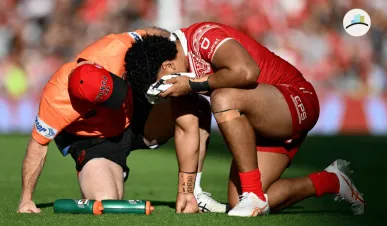
Melbourne Storm forward Eliesa “Eli” Katoa has been ruled out of the entire 2026 NRL season after suffering a frightening head injury while playing for Tonga, an incident that left teammates stunned and the rugby league world deeply concerned.
A Terrifying Afternoon for the Tongan Forward
Katoa endured an extraordinary sequence of head impacts — three in the same afternoon. The first came during warm-up, but he went on to play, where two more heavy knocks followed. As he reached the sideline, the situation worsened. He began experiencing seizure-like symptoms, prompting urgent medical attention and oxygen support.
He was rushed to hospital, where scans revealed bleeding on the brain. Doctors moved quickly, performing emergency surgery to relieve the pressure.
MORE ARTICLES:
Recovery and Return Home
After days of intense monitoring in an Auckland hospital, Katoa was cleared to travel and has now returned to Victoria, where he is continuing his rehabilitation under the care of leading neuro-specialists.
The Storm have already confirmed that the 25-year-old will not take part in preseason and will miss the entire 2026 campaign, saying his long-term health is the only priority.
Club CEO Justin Rodski noted that Katoa is improving daily, calling the recovery “a long road but a positive one so far.”
Questions Over Player Safety
The incident has triggered serious questions about existing concussion and head-injury protocols in rugby league. Critics have pointed out a key flaw: injuries in warm-up are not always covered by strict HIA rules, leaving players vulnerable.
Medical experts have urged the NRL to tighten guidelines, arguing that Katoa’s case should serve as a turning point. Former players have echoed similar concerns, saying the situation simply “should never have reached this point.”
Support From Across the Rugby League Community
The rugby league fraternity — from players and fans to former professionals — has rallied behind Katoa.
Fellow Kiwi and NRL player Te Maire Martin, who has his own history with brain injury, offered to support Katoa and his family. He described recovery from brain trauma as “deeply personal” and warned against setting expectations or timelines.
What Comes Next
For now, Katoa is focused entirely on rest, rehabilitation, and restoring his health. The Storm are in close contact with his specialists, and the club has made it clear that there is no rush for a comeback.
Whether he returns in 2027 will depend on medical advice — but for now, the message is simple: his wellbeing comes first.



