
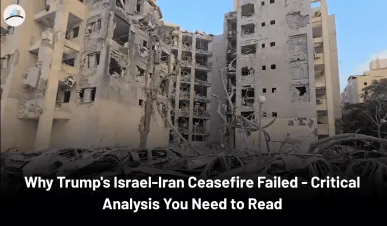
President Donald Trump's dramatic announcement of an Israel-Iran ceasefire on Monday night—delivered via Truth Social rather than traditional diplomatic channels—represents more than just another failed peace initiative. It signals a fundamental miscalculation about modern Middle East dynamics and exposes the growing inadequacy of American diplomatic leverage in an increasingly multipolar world.
🧵THREAD: Why Trump’s Ceasefire Proposal Was a Strategic Trap — Not a Peace Plan
— Nikola (@niktaylorde) June 24, 2025
Let’s break down how the “Iran stops first, Israel stops later” framing was never about peace — and always about winning the narrative. pic.twitter.com/oVAETyFONP
The ceasefire's collapse within hours wasn't merely a setback; it was a predictable outcome that illuminates three critical blind spots in current U.S. foreign policy: the overestimation of presidential authority in complex conflicts, the underestimation of regional actors' autonomy, and the dangerous precedent of conducting high-stakes diplomacy through social media platforms.
The Structural Flaws in Trump's Approach
What makes this ceasefire attempt particularly revealing is not its failure, but the methodology behind it. Unlike the Camp David Accords or even the Abraham Accords, this initiative appears to have bypassed the essential groundwork of multilateral negotiations, regional stakeholder consultation, and preliminary confidence-building measures.
The timeline itself—Iran ceasing strikes at midnight Eastern Time, Israel following 12 hours later—suggests an American-centric framework that ignores regional time zones, local political dynamics, and the basic mechanics of how ceasefires actually function. This isn't diplomatic innovation; it's diplomatic improvisation with potentially catastrophic consequences.
Historical analysis reveals that successful Middle East peace initiatives require months or years of preliminary work. The 1978 Camp David process involved 13 days of intensive negotiations after extensive preparatory diplomacy. The Oslo Accords emerged from secret back-channel communications spanning months. Trump's approach appears to have compressed this timeline to mere hours, if any preliminary work occurred at all.
The Credibility Crisis and Its Cascading Effects
The immediate ceasefire violations expose a deeper problem: the erosion of American diplomatic credibility as a neutral mediator. When the President publicly criticizes both parties for "not knowing what the f*ck they're doing" after his own initiative fails, it damages not just this specific effort but the entire framework of U.S. mediation in future conflicts.
This credibility gap has measurable economic implications. Oil markets' initial 1.8% price drop following the ceasefire announcement, followed by renewed volatility as violations emerged, demonstrates how quickly diplomatic failures translate into market instability. More concerning is the precedent this sets for future crisis management: if markets can't trust U.S. diplomatic announcements, the traditional "flight to safety" toward American-backed stability becomes less reliable.
The timing of Trump's departure for the NATO summit while ceasefire violations were occurring sends a particularly problematic signal to European allies who are increasingly skeptical of American crisis management capabilities in the Middle East.
What's Not Being Discussed: The Iranian Calculus
While most coverage focuses on the ceasefire's immediate breakdown, insufficient attention is being paid to why Iran might have initially appeared to agree to Trump's terms, if they did at all. Iran's regional strategy has shifted significantly since 2021, with stronger ties to Russia and China providing alternative sources of diplomatic and economic support.
The Iranian missile strike on Al Udeid Air Base in Qatar—which houses U.S. military personnel—just before the ceasefire announcement suggests a calculated escalation designed to test American red lines rather than a desperate attempt to end hostilities. This pattern indicates Iran may be using conflicts with Israel as leverage in broader negotiations with the U.S. over sanctions relief and regional influence.
Iran's apparent willingness to violate the ceasefire immediately also suggests confidence that the costs of continued conflict are manageable, possibly due to alternative economic partnerships that reduce dependence on Western markets. This represents a fundamental shift in Middle East power dynamics that traditional U.S. policy frameworks haven't fully absorbed.
Israel's Strategic Autonomy and American Influence
Israel's continuation of military operations despite Trump's public demands to "bring your pilots home" reveals another underreported dynamic: the limits of American influence over Israeli decision-making in existential security matters.
Netanyahu's government appears to be calculating that the strategic benefits of degrading Iranian capabilities outweigh the diplomatic costs of defying American mediation efforts. This calculus is informed by Israel's assessment that Iran's nuclear program and regional proxy network represent existential threats that require military rather than diplomatic solutions.
The timing is also significant: conducting operations while Trump is traveling to a NATO summit minimizes immediate American pressure while maximizing operational freedom. This suggests sophisticated coordination between Israeli military and political leadership that prioritizes strategic objectives over diplomatic relationships.
Hidden Economic Risks: Beyond Oil Price Volatility
While energy market reactions dominate headlines, the broader economic implications of sustained Iran-Israel conflict extend far beyond oil prices. The conflict occurs against a backdrop of shifting global trade patterns, with Middle East shipping routes becoming increasingly critical as companies diversify supply chains away from China.
The Red Sea and Persian Gulf shipping lanes handle approximately 20% of global container traffic. Sustained conflict could force costly rerouting around Africa, adding weeks to delivery times and billions in additional shipping costs. This "hidden tax" on global trade would be particularly damaging given existing inflationary pressures.
Defense spending implications are equally significant but underreported. Both Iran and Israel are likely to accelerate military procurement, benefiting defense contractors but potentially crowding out civilian investment. For Iran specifically, increased military spending could further strain an economy already weakened by sanctions, potentially triggering internal instability.
More Articles:
The NATO Summit Timing: Unintended Consequences
Trump's departure for The Hague while his ceasefire initiative collapsed creates an unintended diplomatic crisis within the Western alliance. European NATO members are increasingly concerned about American reliability in crisis management, particularly given their own exposure to Middle East energy supplies and refugee flows.
The summit now faces the challenge of addressing Middle East stability while the primary mediator's credibility is in question. This could accelerate European efforts to develop independent diplomatic capabilities in the region, potentially marginalizing American influence in future crisis resolution efforts.
French President Macron and German Chancellor Scholz have both advocated for stronger European diplomatic autonomy in Middle East affairs. The visible failure of American-led mediation provides additional justification for these initiatives, potentially reshaping the entire architecture of Western engagement in the region.
Looking Forward: The Systemic Implications
The failed ceasefire attempt reveals systemic problems that extend beyond this specific conflict. Social media diplomacy, while offering speed and direct communication, lacks the institutional safeguards and preliminary groundwork that successful international mediation requires.
More fundamentally, the incident suggests that traditional American diplomatic frameworks—developed during periods of clear regional hegemony—may be inadequate for managing conflicts in an increasingly multipolar Middle East where regional actors have alternative sources of support and legitimacy.
The precedent of conducting high-stakes international mediation through social media platforms raises serious questions about institutional knowledge, diplomatic continuity, and crisis escalation management. Future administrations will inherit not just specific policy challenges but a damaged framework for international crisis response.
As regional powers continue to test American mediation capabilities, the costs of diplomatic failure will likely increase. The next Middle East crisis may find American influence significantly diminished, with potentially catastrophic implications for global stability and economic growth.



