
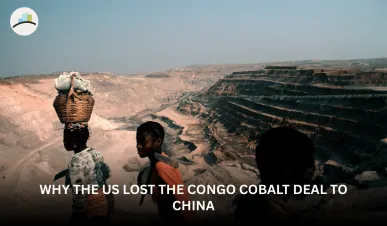
US-Congo Cobalt Deal Collapse: Behind the Scenes of a Global Power Struggle
The unraveling of a $1 billion U.S.-brokered deal with Congo to resolve a long-standing dispute over critical cobalt and copper assets exposes more than a diplomatic misstep. It reveals the deep, slow-burning fault lines in America’s approach to resource diplomacy — and signals a missed opportunity in the intensifying global race for green energy dominance.
Why Did This Happen?
The failed deal stemmed from a complex triangle of interests: the U.S. trying to counter China’s stranglehold over critical minerals; Congo, asserting sovereignty over its vast resources; and business giants like CMOC and Gécamines entangled in opaque financial arrangements.
Washington’s attempt to mediate between Chinese miner CMOC and Congo’s state-owned Gécamines was ambitious but lacked teeth. Congolese officials grew frustrated with what they saw as excessive U.S. interference without tangible benefits. Internal U.S. divisions — between the embassy in Kinshasa, the State Department, and special envoy Amos Hochstein — further weakened Washington’s position.
In essence, the U.S. misread Kinshasa’s priorities. Congo was less interested in geopolitical balancing and more in economic control and resource revenue. When Washington could not deliver clear economic gains fast enough, its leverage diminished.
What Is Not Being Discussed Enough?
While media coverage focuses on the diplomatic tug-of-war, the deeper issue is Washington’s lack of a coherent industrial strategy in Africa. Unlike China, which pairs investment with long-term infrastructure and political alignment, U.S. initiatives often arrive wrapped in caution, legal stipulations, and slow processes.
Moreover, the absence of American mining champions in Congo weakens the credibility of any U.S. resource play. Diplomatic support without commercial muscle is proving ineffective.
MORE ARTICLES:
Hidden Risks and Opportunities
-
Risk: Congo’s shift away from U.S. influence could push it closer to Beijing, deepening China’s grip over the world’s cobalt supply. Given cobalt’s importance in electric vehicle (EV) batteries, this has long-term implications for Western clean tech industries.
-
Risk: If the U.S. fails to secure future resource deals in Africa, it may fall behind in the energy transition, affecting everything from national security to auto manufacturing jobs.
-
Opportunity: This rupture offers the U.S. a chance to rethink its African strategy. Instead of diplomatic pressure, co-investment in processing infrastructure and transparent revenue-sharing could build sustainable influence.
Historical Parallel
This situation echoes Cold War-era resource diplomacy, where superpowers sought influence through aid, extraction rights, and political backing. The difference now is the multipolar competition — with China, the EU, and even Gulf states increasingly active in Africa’s resource future.
Why This Is Important
The collapse of this deal isn’t just a blip — it’s a warning that America’s soft power tools are insufficient in an era of high-stakes resource competition. The green energy race is not just technological — it's geopolitical. And the U.S. is behind.



