
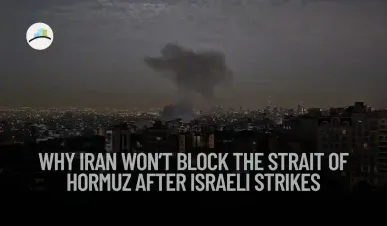
Despite escalating tensions in the Middle East—following Israel’s latest strikes on Iranian nuclear and military facilities—analysts agree that Iran is extremely unlikely to block the Strait of Hormuz. Though Tehran has repeatedly threatened to close the passage in retaliation, the economic and strategic costs of doing so are simply too high.
Why Iran Needs the Strait
The Strait of Hormuz is Iran’s lifeline: around 20–25% of global oil exports and nearly a third of liquefied natural gas pass through daily. If the strait were closed, Iran would cut off its own exports, severely damaging its economy—regardless of opposition from the U.S. or its Western allies.
Also read on Procapitas
Unlike past rhetoric, today Iran relies heavily on these oil revenues, and alternative export routes (like pipelines bypassing Hormuz) remain underdeveloped or politically sensitive .
Political vs Practical Leverage
Iran’s threats to close the strait—common since the 2011–12 crisis—are part of an A2/AD (anti-access/area-denial) strategy: projecting military capabilities using mines, missiles, fast-attack boats, and drones without actual closure .
Many analysts and retired naval officers stress that while Iran possesses these tools, a full blockade is strategically low-probability due to risks of overwhelming retaliation and damage to Iran's own interests .
Why Iran won't block the Hormuz Strait oil artery even as war with Israel looms https://t.co/ZggkDlCO6L
— Caleb McMurtrey (@CalebBMcMurtrey) June 13, 2025
Global Impact from a Hypothetical Blockage
Had Iran closed the strait—especially targeting major export terminals like Kharg Island—oil prices could spike to $85–100+ a barrel, with broader inflation ripple effects . The cost would be shared widely: Iran would lose export income, and global economies would face disrupted energy flows and higher costs.
What Iran Can and Cannot Do
Instead of a full blockade, Iran is more likely to:
-
Seize or mine ships linked to adversaries
-
Harass maritime traffic near Hormuz, without total closure
-
Send proxy threats—often enough to rattle oil markets, but not provoke full-blown war
These strategies have precedent: recent ship seizures and attacks on tankers have served as calibrated signals while stopping short of closure.
Deeper strategic calculus
-
Self-sabotage: Closing Hormuz harms Iran’s export revenue and energy reserves.
-
Diplomatic isolation: A blockade could shut out remaining economic partners like China who rely on free passage .
-
Military reprisal: The U.S. and allies are positioned to respond to a full blockade, making it a potentially suicidal political gamble.
Europe’s EMASoH Mission
Launched in 2020, the European Maritime Awareness in the Strait of Hormuz (EMASoH) mission stems from Iran-centric anxiety. Operated by nine EU nations, it continues to ensure both intelligence monitoring and deterrent patrols—maintaining freedom of navigation amid rising tensions
Bottom Line
While heightened rhetoric will continue, Iran has clear incentive to avoid a full strait blockade. A narrower set of maritime maneuvers can achieve strategic signaling without triggering economic self-harm or military escalation.



