
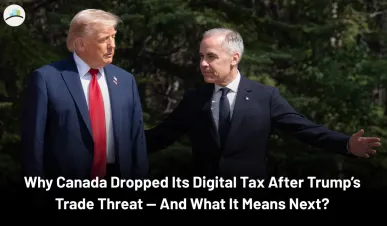
Canada Drops Digital Tax After Trump Halts Trade Talks — What’s Really Going On?
Canada just pulled back its plan to tax big tech companies like Google, Amazon, and Meta. It had planned to charge a 3% tax on the money they make from Canadian users—starting retroactively from 2022. But then, out of nowhere, U.S. President Donald Trump cut off trade talks between the two countries, saying the tax was unfair to American companies. A few hours before the tax would’ve kicked in, Canada backed off.
Now the trade talks are back on, and both sides are hoping to work out a deal by July 21. But this isn’t just about one tax—it says a lot about who has the real power in global tech and trade.
Canada just scrapped its digital services tax after Trump halted trade talks.
— Samantha (@samantha_brin) June 30, 2025
A clear reminder: economic pressure still speaks louder than diplomacy.
The 3% levy on U.S. tech firms didn’t even make it past Day 1.#USCanada #TradePolicy #DigitalTax #Geopolitics… pic.twitter.com/dVctknjEL7
Why Canada Gave In
Let’s be honest: Canada didn’t just change its mind on its own. It was under pressure. The U.S. is Canada’s biggest trading partner. So when Trump stopped all trade talks and warned of possible tariffs, it put Canada in a really tough spot. They could either stick with the tax and risk a big trade fight—or pull it back and keep the talks going.
The tax itself wasn’t a crazy idea. A lot of countries are trying to figure out how to make huge tech companies pay their fair share, especially when they earn tons of money locally but pay little tax. But Canada was going at it alone, and that made it harder to defend when things got tense.
What Most People Aren’t Talking About
One thing that hasn’t been covered enough is the message this sends to other countries. If Canada—a strong, developed country—can be pushed into reversing its tax just because the U.S. didn’t like it, what does that mean for smaller countries? It kind of shows that if you don’t have the economic weight to stand up to the U.S., your policies can get steamrolled.
There’s also a local political angle. Prime Minister Mark Carney is getting heat at home for backing down so fast. Some Canadians saw this tax as a way to stand up to tech giants and push for fairness. Now that it’s been canceled, critics are calling it a retreat—and accusing the government of folding too easily under pressure.
What This Means for Tech and Trade
For U.S. tech companies, this is a win. They get to avoid paying billions in extra taxes—at least for now. That money would’ve gone straight into Canada’s public funds. Instead, it stays with the companies. And honestly, that sets a pattern. If big companies can get out of paying local taxes just by having their government threaten trade consequences, that’s going to make global tax reform a lot harder.
From a trade perspective, Canada made a move that avoided a major blow-up. The two countries trade hundreds of billions every year. A fight would’ve hurt both sides. But giving in may also weaken Canada’s position in future talks. They’ve shown that they’ll back off when things get tough.
More Articles:
Will Other Countries Do the Same?
That’s the big question. Places like France and India have tried similar digital taxes, and in some cases, the U.S. pushed back hard there too. But this case might be more powerful because of how quickly Canada reversed course. It could scare other governments away from trying to tax these companies on their own.
It also puts more pressure on international efforts like the one led by the OECD, which is trying to create a global digital tax agreement. If countries keep getting pushed around when they act alone, the only option may be to work together. But even that’s not easy, and progress has been slow.
What Happens Next?
For now, trade talks between the U.S. and Canada are back on. The digital tax is off the table, but it might return later in a different form—maybe something tied to a global agreement.
Still, this whole thing leaves behind a bigger message: tax policy in the digital age isn’t just about numbers—it’s about politics, power, and who can afford to say no. Canada couldn’t, this time.



