
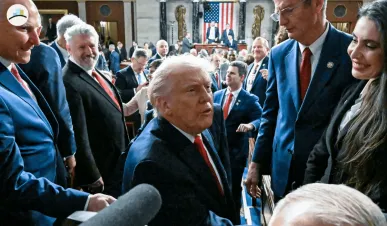
Washington, D.C. — A tense moment occurred during President Donald Trump’s State of the Union address in 2026 as he spoke to a joint session of Congress when U.S. Rep. Al Green (D-TX) was escorted out of the House chamber for staging a protest over racist imagery that had been circulated on social media.
Rep. Green’s Protest Over Racist Imagery of Obama
The protest occurred as President Trump spoke to Congress. Rep. Green stood up in the House chamber with a sign that read “Black people aren’t apes,” protesting racist imagery that had been tied to a video that was widely panned as racist. The image, which included former President Barack Obama, the country’s first African American president, and other African American politicians who were given primate likenesses, sparked widespread outrage among Democrats, civil rights groups, and members of both parties.
Rep. Al Green was escorted out of the House chamber during President Donald Trump's State of the Union address after staging a silent protest and unfurling a sign reading "BLACK PEOPLE AREN'T APES!". pic.twitter.com/rd2e1qizP8
— Al-Jarmaq News (@Aljarmaqnetnews) February 25, 2026
Tension in the House Chamber as Green Stands Firm
As Green stood in front of the podium where President Trump was speaking, he refused repeated requests from Republican lawmakers and chamber officials to lower the sign. After several tense moments, House security staff approached Green and escorted him out of the chamber, drawing gasps from onlookers and stirring immediate reaction on the House floor.
The incident marked a rare public disruption inside the traditionally solemn and ceremonial atmosphere of the State of the Union. In recent years, partisan tensions have occasionally spilled into moments like these, but it remains highly unusual for a member of Congress to be physically removed during such a high-profile presidential address.
MORE ARTICLES:
Green’s Moral Imperative: Defending Human Dignity
After being escorted from the chamber, Green described his protest as a moral imperative. He told reporters that he could not remain silent in the face of imagery that he viewed as clearly racist and harmful. He argued that leaders — especially those in the highest office — must be held accountable for the symbols they propagate and the messages they amplify. Green reiterated that defending basic human dignity is not a political exercise but a responsibility of elected officials. Green reiterated that defending basic human dignity is not a political exercise but a responsibility of elected officials.
White House Reaction: Video Removed, Trump’s Apology
The White House removed the video in question from its official social media page in reaction to the public outcry. Later, President Trump explained that the derogatory part of the video had been uploaded to the internet by one of his staff members without his actual knowledge. Trump apologized for the video’s derogatory content against people of a particular race, claiming that his administration does not support racist content, although many people doubted the authenticity of his apology.
The Racist Imagery: Blackface and Primate Depictions
The video went viral on the internet, first appearing on social media pages associated with Trump’s political ideology. Critics of the video argued that it used blackface and primate depictions, which have been used in the past as racist imagery to dehumanize Black people. Civil rights organizations called the video’s imagery “outrageous” and argued that it relied on derogatory stereotypes with no place in public discourse.
Republican Reaction: Trump Defended, Green Attacked
The Republican members of Congress have largely ignored Green’s protest as a political ploy, suggesting that Green is attempting to disrupt the decorum of the State of the Union address and draw attention away from the president’s policy agenda. Members of the Republican Party have also suggested that the removal of Green was a necessary enforcement of house rules, as disruptions of this type are rare during such speeches.
Democratic Response to Green’s Protest
However, Democratic members of Congress have rallied around Green’s right to protest. Some members have expressed concern that the removal of a member of Congress during the speech may indicate a problem with free speech and the resolution of grievances within the legislative branch. Those critical of the administration have suggested that the controversy surrounding the video is indicative of a racial divide within American politics, one that has grown wider in recent years.
Civil Rights Leaders Weigh In: The Role of Political Leaders in Managing Racism
Many observers also suggested that elected officials should be more careful about the information disseminated in their name, particularly when it comes to symbols or images that have a history of being used in a racially damaging way.
Political and Racial Polarization at Play in U.S. Politics
The removal of Green from the protest and the removal of the statue also illustrate the ways in which racial politics remain inextricably linked to politics in the United States. As the country approaches the midterm elections and considers questions of social justice, equality, and political rhetoric, this event is likely to become a rallying cry in larger debates about how elected officials use race and representation.
What’s Next? The Future of AI Regulations and Political Protests
Whether this event will have any kind of lasting policy or political impact is difficult to say, but it has certainly sparked a lively debate. In an age of polarized politics and intense media focus, incidents such as these serve as a reminder that symbolism, race, and political protest continue to be very powerful forces in American politics.



