
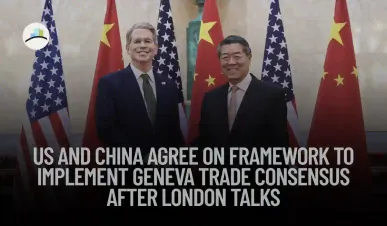
June 11, 2025 | London – The United States and China have agreed to a framework to implement the Geneva Trade Consensus after two days of in-person negotiations in London. The new understanding reaffirms commitments made during the June 5 presidential phone call and outlines key steps to prevent further escalation in the ongoing trade dispute.
The talks were led by U.S. Commerce Secretary Howard Lutnick and China’s Vice Minister of Commerce Li Chenggang. Both parties described the sessions as constructive and goal-oriented. While the framework is not yet binding, it reflects renewed momentum toward easing friction in one of the world’s most closely watched trade relationships.
More Articles:
What’s in the framework
The London framework includes the following elements:
-
A 90-day mutual pause on additional tariffs
-
Steps to ease China’s export restrictions on rare earth elements
-
Plans to soften U.S. controls on semiconductor and AI chip exports
-
A draft mechanism for dispute resolution and compliance monitoring
-
Provisions for regular high-level engagement every 30 days
While the framework does not remove existing tariffs entirely, it halts the imposition of new measures scheduled for July and August. Both countries emphasized the importance of stability in supply chains and mutual growth.
“U.S.-China agree on framework to implement Geneva #trade #consensus.” 🤝 🇺🇸 🇨🇳 https://t.co/awHlhy4gIz
— David South (@DSChallenges) June 11, 2025
Background and Geneva context
The Geneva consensus, reached in May 2025, was intended to cool tensions after tit-for-tat tariff increases disrupted trade flows between the two largest economies. However, disputes over critical minerals and export licenses for advanced technology hindered timely implementation.
June’s London talks were arranged to salvage that agreement, following a phone call between President Trump and President Xi that set the tone for compromise. Officials said the current framework reflects a middle ground shaped by those instructions.
Market reaction
Investors welcomed signs of progress. Asian markets closed higher on the day:
-
Nikkei 225: up 0.6 percent
-
Hang Seng Index: up 0.9 percent
-
Kospi Index: up 1.0 percent
U.S. stock futures and the S&P 500 also edged upward, reflecting cautious optimism. Analysts noted that a formal deal would have a more meaningful impact, but the current pause reduces near-term uncertainty for global trade, tech, and manufacturing sectors.
Next steps and policy outlook
Officials clarified that the framework is subject to final review and sign-off by Presidents Trump and Xi. A joint statement or formal agreement is expected by the end of June. In the meantime, working groups will continue drafting technical language on compliance, data sharing, and enforcement.
Commerce Secretary Lutnick said the aim is to build a “predictable, fair, and rules-based” trade system. Chinese negotiator Li Chenggang echoed this sentiment, calling the process “respectful, pragmatic, and based on mutual interest.”
Analysts believe that if implemented, the framework could help both nations avoid further economic strain and rebuild some trust in trade cooperation.



