
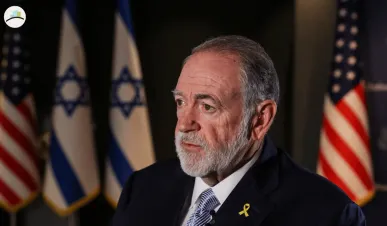
A single comment by U.S. Ambassador to Israel Mike Huckabee has set off a wave of controversy, drawing intense reactions from across the Middle East. What initially seemed like a routine interview quickly turned into an international diplomatic incident that put the spotlight on the nuances of U.S. policy, the sensitivity of Israeli-Palestinian relations, and the fine line diplomats must walk when speaking on behalf of their country.
The Comment That Triggered the Backlash
US says ambassador’s comments on Israel and the Middle East were taken out of context https://t.co/WP47jsjfmJ
— POLITICO (@politico) February 23, 2026
It all started when Huckabee, in an interview with a conservative commentator, made a remark that many in the Middle East viewed as suggesting Israel’s right to claim vast territories beyond its current borders. Specifically, Huckabee was asked about Israel’s historical connection to land in the region, and in response, he made a statement that was widely interpreted as implying Israel could expand its territory. The comment was not directly calling for territorial aggression, but it nonetheless sparked a storm of reactions.
Immediately, governments across the Middle East expressed their concern, with many leaders accusing the U.S. of endorsing ideas that could destabilize the already fragile situation in the region. Some saw Huckabee’s words as reinforcing longstanding fears about Israeli expansionism, even though the ambassador later clarified that his comments had been “taken out of context”.
MORE ARTICLES:
The U.S. Responds: Clarifying the Intent
Following the uproar, the U.S. government quickly moved to distance itself from Huckabee’s remarks. Officials emphasized that the ambassador’s statement was not intended as a change in U.S. policy. The U.S. still supports Israel’s security, but has reiterated its commitment to a two-state solution for Israel and Palestine, a diplomatic goal that has guided U.S. policy for decades.
Huckabee himself, in a follow-up explanation, noted that his comments were misinterpreted, and that he did not mean to suggest that Israel should or would seek additional territory. However, the damage was done, and the conversation quickly shifted from a diplomatic gaffe to deeper questions about the role of U.S. ambassadors in shaping international policy through their words and actions.
Why This Matters for the Middle East
The significance of this incident lies not only in Huckabee’s comment but also in how it was received in the Middle East. The idea of Israel expanding its borders, especially at the expense of neighboring Arab countries, remains one of the most sensitive topics in the region. While the U.S. has long been a strong ally of Israel, its role as a mediator in the Israeli-Palestinian conflict has been fraught with complications.
Countries in the Middle East, particularly those in the Arab League, were quick to denounce Huckabee’s comment, seeing it as a validation of Israeli territorial claims. For them, the comment was not just a minor slip-up — it was a potential signal that the U.S. might be shifting its position on longstanding principles of peace and diplomacy in the region.
Many felt that the remark, even if unintended, opened the door to the possibility that U.S. support for Israel could be moving away from diplomatic negotiations toward a more unyielding stance on Israeli territorial control.
The Complexity of U.S. Foreign Policy
The incident brings into focus the complexities of U.S. foreign policy in the Middle East, particularly the challenges of balancing support for Israel with the desire to maintain peace and stability in the region. The U.S. has historically been an advocate for a negotiated peace process between Israelis and Palestinians. However, with Israel’s growing settlements in the West Bank and continued violence in Gaza, U.S. officials have often struggled to maintain a neutral stance.
The United States’ role as a global power means that statements made by high-ranking officials like Huckabee carry immense weight, even when they are not intended to reflect official policy. This creates a tightrope that diplomats must walk: the pressure to maintain strong alliances with countries like Israel, while also being seen as an impartial broker in peace efforts.
Diplomatic Tightrope: Trust and Accountability
The real issue, though, isn’t just about this one comment — it’s about how statements like these erode trust in the U.S. as an honest broker for peace. Leaders in the Middle East are particularly sensitive to any shifts in U.S. rhetoric because they directly impact the balance of power in the region. If they feel that the U.S. is no longer committed to a balanced approach, it risks alienating crucial allies and undermining any hope for a peaceful resolution to the Israeli-Palestinian conflict.
As the U.S. works to rebuild its relationship with key Middle Eastern players and regain trust, comments like Huckabee’s serve as a reminder that words matter — particularly in such a politically and culturally charged environment.
Moving Forward: Accountability and Diplomacy
In the wake of the controversy, there are questions about how the U.S. will handle its diplomatic communications in the future. The U.S. government has walked back Huckabee’s statements, but it’s clear that the comments raised more than just questions about his personal judgment. They raised important issues about how U.S. diplomats represent the nation’s interests abroad and how those interests are communicated to the world.
Moving forward, the U.S. must be mindful of the potential consequences of every diplomatic statement — particularly when it comes to such a complex and sensitive region. For many in the Middle East, this incident was a reminder that even a single comment can tip the scales of diplomacy, for better or for worse.
Conclusion: A Warning for the Future of U.S. Diplomacy
While the controversy around Huckabee’s remarks may eventually fade, the underlying issues remain. This incident underscores the importance of careful, thoughtful diplomacy in a region where every word can be interpreted through multiple lenses. As the U.S. seeks to navigate its complex relationship with Israel and its neighbors, it must be more mindful than ever about the messages it sends — even in casual conversations.
The hope is that future interactions will reflect a deeper understanding of the region’s complexities and the need for careful, responsible communication. For now, the U.S. is left with the task of repairing trust in its diplomatic efforts — one conversation at a time.



