
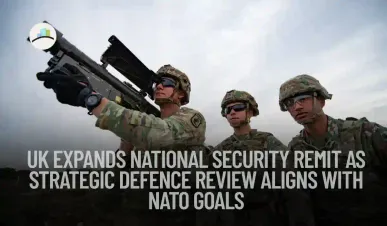
The UK has unveiled a significant expansion of its national security framework, aligning more closely with NATO’s heightened defence ambitions. As part of a new Strategic Defence Review (SDR), the government plans to integrate cybersecurity, electronic warfare, and intelligence under a unified command, marking a notable shift toward modernised, high-tech warfare preparedness.
The changes come in the context of NATO urging member states to boost military spending significantly, with proposals reaching 3.5% of GDP (and targets up to 5% including cyber and infrastructure). The UK has committed to raising defence spending to 2.5% by 2027, with a potential rise to 3% by the early 2030s—and an internal mandate to invest more in advanced weaponry and resilience against evolving threats.
Key Elements of the Strategic Defence Review
-
The SDR consolidates cyber operations and electronic warfare into a single National Cyber and Electromagnetic Command, enhancing coordination across AI-driven battlefield domains.
-
An additional £1 billion investment will go toward developing a “digital targeting web” to process battlefield data using artificial intelligence, linking sensors, weapons, and command systems.
-
Spending on munitions will increase, with six always-operational facilities producing long-range missiles and bomb factories to bolster NATO and domestic stocks.
-
Plans include building SSN‑AUKUS submarines across UK shipyards, expanding the army to approximately 76,000 personnel, and establishing a new CyberEM Command.
-
Overall defence expenditure is set to rise to 2.5% of GDP by 2027, with ambitions of reaching 3% by the next parliament—though achieving NATO’s 3.5% guideline remains contentious.
More Articles:
Strategic Context and Political Balancing
These reforms follow Nato Secretary-General calls for allies to boost core military spending to 3.5% of GDP and defence-related spending to 5%. Recent reports show some NATO countries considering these benchmarks, but the UK has resisted making firm commitments beyond 3%.
The review also outlined a broader vision: investing in AI capabilities, securing state supply chains, and preparing for escalating threats from Russia, Iran, cyber actors, and hybrid warfare.
While the government raises funds partly through reallocation from overseas development, critics argue that long-term fiscal commitments and transparency are lacking given the scale of ambition.
What This Means for NATO and Global Security
-
The SDR reinforces the UK’s “NATO‑First” posture, ensuring interoperability and burden-sharing with allied forces.
-
Investment in cyber and electronic warfare positions the UK to meet the challenge of modern, asymmetrical threats emerging from state and non-state actors.
-
Expanded munitions production represents a strategic adjustment after observed stock depletion due to military support for Ukraine.



