
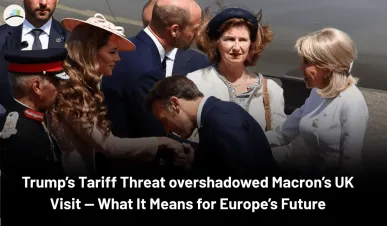
Macron came to talk peace, progress — but headlines had other plans
French President Emmanuel Macron’s state visit to the UK was supposed to be a reset. He came to reconnect with Britain, rebuild some trust post-Brexit, and talk seriously about things like defense, tech, migration, and energy. It was a carefully planned diplomatic event, with all the royal gestures, speeches, and strategic meetings you'd expect.
But then, right in the middle of it, Donald Trump’s name grabbed the front pages again. Reports started surfacing that he’d sent letters to key U.S. allies, including Japan and maybe some in Europe too, warning about potential tariffs if trade balances didn’t shift in America’s favor. That changed the tone of the whole week.
Macron arrived in the UK, a country he hadn’t visited since 2008.
— Zlatti71 (@Zlatti_71) July 8, 2025
The visit began with a touch of family drama: Brigitte refused to take his hand and confidently descended the plane steps on her own — like a man.
Well, at least she didn’t hit him this time like in Vietnam.
- SK pic.twitter.com/CBjMZ8Ac0D
The visit had bigger goals than handshakes
This trip wasn’t just a friendly stopover. Macron and UK leaders had serious plans: tighten military coordination, work on AI and cyber defense, address border control challenges, and even push for more joint clean energy funding. It was supposed to show that Europe can come together—even with its differences—and act like a reliable power block.
But when you’ve got the U.S. threatening trade action in the background, suddenly every business and political conversation feels shaky. Some people even started wondering—will Trump do to Europe what he’s hinting at with Japan?
What no one’s really saying out loud
Here’s what’s slipping through the cracks in the coverage:
Europe’s still not fully in control of its narrative. Macron is pushing hard for something called “strategic autonomy”—a Europe that doesn’t wait for Washington or Beijing to call the shots. But when a single letter from Trump can throw a whole state visit off course, it kind of shows how far that goal still is.
Defense deals rely on trust. Macron wanted to move forward on defense tech and cybersecurity, but those things depend on supply chain stability and shared confidence. If there’s uncertainty over what the U.S. might do next, even allies hesitate. That makes joint projects riskier, especially when they involve tech or long-term funding.
Investors are paying attention. Macron also met with big UK investors to talk green energy and startups. But if people think the global trade environment is shifting—especially with the U.S. taking a hard line again—they may hold back, or redirect money elsewhere.
More Articles:
Trump’s trade message hit harder than expected
No one’s denying that Trump’s letters were meant to show strength. They were classic pre-election positioning: “America First,” protect our jobs, fix the trade deficit. But it’s how loud the ripple got that surprised people. A quiet visit between two old allies got completely sidelined, just because of what Trump might do in the near future.
That shows how powerful even the idea of U.S. economic aggression is. Macron didn’t even mention it publicly, but you could tell that everyone—from diplomats to investors—was watching the situation closely.
Could this change Europe’s strategy?
Maybe. If countries like France and the UK keep getting caught off guard by U.S. political moves, it could push them to build more independent trade and defense paths. We might see Europe leaning more toward Asia-Pacific, or doubling down on intra-European partnerships. No one wants to be too exposed when policies flip overnight.
At the same time, this isn’t about turning away from the U.S.—it’s about having a backup plan. Because right now, even close allies feel the tremors when U.S. politics heat up.
Final thoughts
Macron’s visit to the UK wasn’t a failure. But it didn’t land the way it was meant to. The timing of Trump’s trade threat was just too loud to ignore, and it changed the story completely. It’s a reminder that in today’s global politics, even a handshake between old allies can be overshadowed by a single warning from across the Atlantic.
If Europe wants to really stand strong on its own, it’ll need more than partnerships and speeches. It’ll need to learn how to hold the spotlight—even when someone else is trying to take it.



