
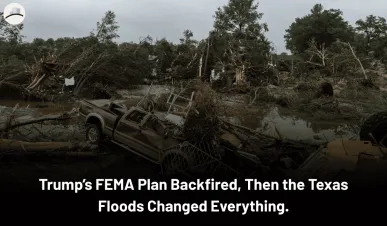
FEMA Was Almost Gone. Then the Texas Floods Changed Everything.
Something pretty big happened in Texas last week, and it might’ve just saved FEMA from being shut down completely. If you’ve been following the news, you know about the massive floods that hit Central Texas — places like Kerrville and nearby towns were hit the hardest. Over 120 people died, and way more are still missing. It’s heartbreaking. Entire families were swept away, and many are still waiting to hear about their loved ones.
And honestly, this disaster came at a time when FEMA — the federal agency that helps during stuff like this — was kind of on thin ice. The Trump administration had been talking for months about either completely shutting FEMA down or changing it into something smaller that would leave most of the responsibility to states. But after seeing what just happened in Texas, that plan seems to be on pause.
#BREAKING 🚨 | 🇺🇲 President Trump's admin has backed away from abolishing the Federal Emergency Management Agency (FEMA), ahead of the president's visit to flood-hit Texas » WaPo#UnitedStates | #Texas | #FEMA pic.twitter.com/QicaSLNkBU
— The Election Post (@ElectionPostUSA) July 11, 2025
Why the Situation Got So Bad So Fast
What really made this disaster worse was how fast everything happened — and how slow the response was. A rare kind of storm, the kind that dumps tons of rain in just a few hours, hit the area hard. Some towns saw over 20 inches of rainfall in a day or two. Places like Hill Country are already prone to flash floods, and when that much water comes down all at once, there’s not much time to react.
Now here’s where things get serious: FEMA wasn’t able to respond as quickly as it should’ve. Why? Because of some recent changes that require the Department of Homeland Security to approve contracts over $100,000. That meant things like setting up shelters, sending out search teams, or even running emergency phone lines got delayed. People on the ground needed help, and the help was stuck in paperwork.
This isn’t just about a slow response — it’s also about cuts made earlier this year. Budgets for federal weather services were slashed, so warnings weren’t as strong or clear as they used to be. Local counties, like Kerr County, didn’t even have flood sirens. Some kids at summer camps never got a warning at all. That shouldn’t happen.
What People Aren’t Really Talking About
There’s a lot of media coverage around the flood, but some things still aren’t getting enough attention. Like, for example, the way this disaster affected people differently depending on where they live. Wealthier neighborhoods had better alert systems. Some even had private sirens. But in smaller or rural areas, there was nothing. So it ended up being the poorer communities and kids at remote camps who paid the price. That feels really unfair.
And there’s also this other part no one’s really talking about: housing. After disasters like this, people lose their homes. FEMA usually steps in with temporary housing or emergency money. But if FEMA’s powers or budgets keep getting cut, what happens next time? We might see a huge rise in evictions or families forced to borrow money at high interest just to survive.
Some lawmakers are worried too — not just about FEMA’s funding, but about how aid is being handed out. Data shows that requests for disaster help in Democrat-run states are being denied more often than in Republican-run ones. That’s not a good sign. Disaster help should be fair, no matter where you live or who runs your state.
MORE ARTICLES:
What This Means for the Future
The Texas flood is a wake-up call. We’re living in a time when disasters are becoming more common and more extreme. And if we keep cutting funding, laying off FEMA staff, and adding more red tape, we might be setting ourselves up for even worse outcomes down the line.
Here’s what could happen if things don’t change:
-
Local governments will have to carry more of the burden, and many just aren’t prepared.
-
More people could lose homes and jobs after disasters, with fewer safety nets.
-
Businesses might start pulling back from areas they see as too risky to invest in.
-
Public trust in disaster response could drop even further if people think politics is getting in the way.
On the flip side, there’s an opportunity here. If the government really wants to “restructure” FEMA instead of scrapping it, now’s the time to make it stronger, faster, and more fair. That means investing in better alert systems, streamlining response times, and making sure aid gets to the people who need it most.
Final Thought
This disaster in Texas changed the tone in Washington — at least for now. Plans to kill off FEMA are no longer front and center. But it shouldn’t take a tragedy to make us realize how important this agency really is. What we saw in Texas isn’t just about rain and flooding. It’s about how fragile the system is when federal support is pulled back too far.
And honestly, if this had happened a few months later — after more cuts — things could’ve been even worse. That’s what’s scary. We need to be asking bigger questions now: Are we ready for the next one? Is FEMA still strong enough? Are we protecting the people who’ll be hit the hardest?
Because if we’re not, we might not get a second warning.



