
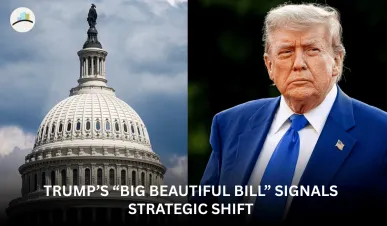
When former President Donald Trump ceremoniously signed what he called a “big, beautiful bill” into law this week, headlines focused more on his trademark bravado than the strategic implications behind the legislation. But beneath the media spectacle lies a calculated political and economic maneuver designed to shift the narrative ahead of the 2024 presidential election and potentially reshape the U.S. domestic agenda for years to come.
When will Trump’s ‘Big Beautiful Bill’ take effect? Here’s what comes next https://t.co/5b0fdEOXu1 via @AJEnglish
— @Suzzay (@suzanzkelley) July 5, 2025
Why This Happened: A Political Power Play Dressed in Populism
The bill, centered around tax incentives, infrastructure reallocation, and energy independence, is not random—it’s timed. Trump’s team is well aware that economic anxiety is peaking again, particularly with the Fed’s sticky interest rates and ongoing labor market uncertainties. By pushing this legislation now, Trump is positioning himself as both an economic savior and a nationalist architect—two images that resonate deeply with his voter base.
Unlike prior bills that were heavily partisan or narrowly focused, this legislation carries broader populist appeal. It's loaded with symbolic wins: domestic manufacturing boosts, tougher regulations on foreign tech firms, and energy projects in key battleground states.
What the Media Isn’t Discussing Enough
1. The Strategic Use of “Economic Nationalism”:
This bill rekindles themes from Trump’s first term—“America First,” manufacturing revival, and energy dominance. But the nuance here is its shift toward de-risking rather than decoupling. The U.S. isn’t trying to cut ties with China entirely—it’s building buffers. Quiet clauses tucked in the bill create a roadmap for selective disengagement from foreign supply chains, especially in sectors like rare earths and semiconductors.
2. State-Level Power Dynamics:
This law may heavily benefit red states due to targeted federal investments. The bill steers subsidies and development incentives toward regions with Trump-friendly governors, essentially rewarding political loyalty with federal dollars. This is a calculated move to consolidate his coalition well ahead of the primaries.
More Articles:
Unspoken Consequences: Winners and Hidden Risks
Business Opportunity:
Construction firms, energy startups, and logistics companies will likely see a short-term boom as government contracts open up. Domestic manufacturers, particularly in steel, rare earths, and microchips, stand to gain.
Risk to International Relations:
Provisions that limit foreign firms’ access to U.S. energy and infrastructure projects could trigger WTO disputes or retaliatory tariffs from allies—not just rivals. Europe, for instance, may see this as another blow to transatlantic trade fairness.
Long-Term Economic Risk:
By prioritizing subsidies and protectionism, the bill may temporarily boost output, but it could sow inefficiency long-term. History offers parallels: Nixon’s wage-price controls in the 1970s had populist appeal but ultimately distorted the economy.
Expert Take: A High-Stakes Gamble for 2024
Dr. Amelia Roth, a political economist at Georgetown, notes, “This bill is less about economics and more about symbolism. It’s Trump’s way of saying, ‘I still control the economic narrative.’ The real risk is if the bill inflates short-term expectations without delivering durable growth.”
Trump understands media moments better than most, but this legislation shows a deeper layer of political craftsmanship. It’s not just about signing something big. It’s about cementing the idea that only he can lead America’s economic “renaissance.”
Why This Is Important
This bill is a temperature check on America’s ideological direction. Are we leaning into protectionism again? Will Trump-era economic doctrines be re-normalized? More than policy, it signals political momentum. And that matters more than ever in a deeply polarized election cycle.



