
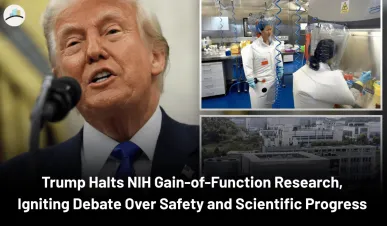
The Big Decision
So, here’s the deal. On July 16, 2025, the Trump administration did something that’s causing quite a stir. They’ve ordered the National Institutes of Health (NIH) to stop 40 virus-related experiments, specifically ones involving something called "gain-of-function" (GOF) research. This kind of research is where scientists take viruses and tweak them to better understand how they evolve, hoping to figure out how they might become more dangerous or how to stop them. Sounds pretty intense, right? Well, the move has sparked a lot of debate, and it’s not just about science; there’s a political layer here too.
The Trump administration appointed an anti-science executive of the NIH as COO who of course had no scientific background. And just as quickly, he was fired for steering contracts to his wife.
— constans (@constans) July 16, 2025
They're not just anti-science, they're also corrupt and stupid. pic.twitter.com/aAGCV53YiA
Why the Halt?
The Trump administration’s reasoning? It’s all about safety. After all, the idea of making viruses more dangerous to study (even if it’s for medical reasons) feels a bit risky. With the whole world still dealing with the aftershocks of COVID-19, it’s easy to see why people are worried. There are voices out there that are pointing to the possibility of a virus leaking from a lab as a contributing factor to the pandemic, and this new decision seems to align with those fears. Critics have long questioned the risks of gain-of-function research, and Trump’s action looks like a direct response to those concerns.
What’s at Stake for Scientists?
This has thrown a wrench in the works for researchers who rely on this kind of research to develop vaccines and study diseases. People like Sarah Stanley, a researcher at UC Berkeley, have argued that gain-of-function research is essential for finding solutions to things like tuberculosis. It’s been used to figure out how viruses could evolve and what that means for public health. Shutting down these studies might slow progress on treatments for diseases that affect millions around the world.
Honestly, there’s a real frustration here. A lot of these studies have been ongoing for years, and they’re seen as standard practice in the scientific community. But now, with this new decision, there’s uncertainty. Will other studies be halted? Will funding disappear? These questions are hanging in the air.
More Articles:
Political Impact
But here’s where things get interesting. It’s not just about science. The political implications of this move are massive. The Trump administration has been making waves for a while now with its approach to public health and scientific research. Halting this kind of research could be seen as another sign that the current government is willing to step into areas that were once considered off-limits to politics—areas that were traditionally left to experts in the field. Some argue that political interference could become more common in scientific research, which could have far-reaching effects on how future research is done.
This isn’t just a Trump issue either; it could influence future policy-making around science and medicine, especially if other administrations follow suit. Imagine a future where government oversight of research becomes a normal thing. It’s a slippery slope, for sure.
What Now?
So, where does this all go from here? Well, it’s still pretty early to tell. There’s a lot of pushback from the scientific community, so it’ll be interesting to see if there’s any reversal or compromise on this decision. But if this move sticks, we might see more restrictions on what kind of research gets funded, and possibly even a shift in how science is conducted in the U.S.
One thing’s for sure: this decision has added another layer of complexity to the conversation about how we balance safety with the need for scientific progress. It’s a tricky issue, and right now, the future of research on viruses and public health is hanging in the balance.
Conclusion
The Trump administration’s decision to halt NIH’s gain-of-function research is definitely a bold one, but it also raises more questions than answers. Will it help prevent a future pandemic, or will it limit progress on crucial medical research? Time will tell, but the debate about how to manage research in this sensitive area is only just beginning. One thing we know for sure: this isn’t the last we’ve heard of this issue.



