
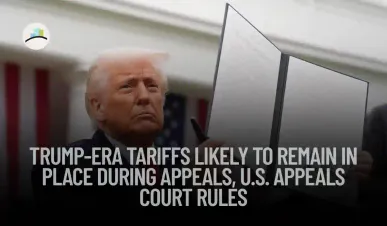
June 11, 2025 | Washington D.C. — A federal appeals court has granted the Trump administration’s request to maintain sweeping import tariffs while legal challenges play out, further extending trade uncertainty for U.S. businesses and consumers.
In a ruling by the U.S. Court of Appeals for the Federal Circuit, judges suspended a May 28 decision by the U.S. Court of International Trade—which had invalidated tariffs imposed under former President Trump’s emergency powers—while a full “en banc” hearing is scheduled for July 31. The judicial stay means tariffs will remain active for at least the next two months.
Read More on Procapitas:
Background and legal context
In April 2025, Trump invoked the International Emergency Economic Powers Act (IEEPA) to implement what he dubbed “Liberation Day” tariffs—retaliatory duties of 10 percent on imports from most U.S. trading partners, plus higher levies targeting China, Canada, and Mexico. The administration claimed these revenues would address trade deficits and fund domestic priorities including drug enforcement.
However, a three-judge panel at the U.S. Court of International Trade ruled the IEEPA does not grant the president authority to impose such tariffs, declaring them unlawful and issuing a permanent injunction .
In response, the Justice Department appealed and requested a stay, arguing that halting tariff enforcement would undermine ongoing diplomatic and trade efforts, weaken national security, and unbalance treaty negotiations .
Trump tariffs may remain in effect while appeals proceed, U.S. appeals court rules https://t.co/55mbuRWfpL
— Investor Central Club + STAX AI (@ICtradeideas) June 11, 2025
What the appeals court decided
On June 10, the Federal Circuit issued a brief ruling extending the lower court’s pause on the injunction, allowing tariff collection to continue. The court cited the case’s “exceptional importance” and scheduled expedited, full-court review for July 31 .
Until a final verdict emerges, all duties under the Liberation Day policy—including 10 percent global tariffs and targeted rates against China, Canada, and Mexico—remain in effect .
Reactions from business and trade groups
Importers have expressed growing frustration, contending the ongoing obligations create cash flow pressure and supply chain delays. Jonathan Gold of the National Retail Federation cautioned that volatility in tariff enforcement is leaving firms "numb to policy shifts" and urging swift resolution .
At the same time, plaintiffs—consisting of five small businesses and several state attorneys general—warned that being burdened with tariffs during litigation could bankrupt some businesses, noting that refund outcomes won’t matter if companies collapse beforehand .
Government lawyers argued the tariff collection is justified by national security concerns and that sudden removal would disrupt key foreign-policy tools .
Implications for trade policy and the economy
The decision has several layered ramifications:
-
Ongoing trade disruption: Tariffs remain in place, continuing to increase costs for U.S. importers, impacting pricing in consumer markets.
-
Legal precedent: The upcoming full hearing will determine presidential authority to impose trade tariffs without Congressional approval.
-
Policy uncertainty: Businesses face prolonged uncertainty over the tariff landscape and potential future reversals.
-
Global diplomacy: Allies like Canada, Mexico, and China remain affected amid recent signals of a possible trade truce .
What to expect next
Both sides must file briefs ahead of the July hearing. Once arguments conclude, a binding panel decision is likely. If unsuccessful, parties may seek review by the Supreme Court, potentially dragging the case into late 2025 or early 2026.
Until then, businesses must adjust to an unclear tariff regime, where duties remain legally enforced amid legal back-and-forth.
Source
CNBC – Trump tariffs may remain in effect while appeals proceed, U.S. appeals court rules



