
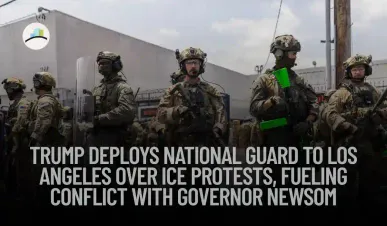
In a dramatic escalation of federal-state tensions, President Trump mobilized up to 4,000 National Guard troops and 700 U.S. Marines to Los Angeles on June 7, 2025, citing rising civil unrest following widespread Immigration and Customs Enforcement (ICE) raids. The predominantly peaceful demonstrations quickly triggered a political and legal showdown with California Governor Gavin Newsom, who has condemned the move as an unconstitutional overreach and filed suit.
What Triggered the Federal Military Presence?
The controversy began with ICE enforcement operations targeting undocumented individuals in workplaces across Los Angeles. While these actions sparked public concern and protests—mainly around downtown federal buildings—the protests remained largely nonviolent. Despite local claims that LAPD could manage the situation, the Trump administration invoked the Insurrection Act and federalized guard and marine units to protect federal property.
Also read on Procapitas
Governor Newsom Responds with Legal Pushback
Governor Newsom immediately denounced the order as "unwarranted federal intrusion" and a provocation. Within two days, California filed Newsom v. Trump, seeking a temporary restraining order (TRO) on the deployment—arguing that the president bypassed lawful channels under 10 U.S.C. § 252, violated the Posse Comitatus Act, and infringed on state sovereignty under the Tenth Amendment.
On June 12, the Northern District of California judge issued the TRO, restoring control of the Guard to the state, though an appeals court stayed that ruling pending further review—allowing federal troops to remain temporarily.
Perhaps it's fitting that this outrageous ruling against Trump's deployment of the National Guard comes at the same time as the Middle East explodes. You simply can not have federal judges overrule the President's military decisions.https://t.co/TU5pydzsdE
— Dave Rogers (@iahphx) June 13, 2025
Troops Express Low Morale Over Mission
Advocates for military families and service members report that morale among the deployed Guard and Marines is low. Troops describe feeling like political tools in a mission they view as unnecessary. Reports indicate poor accommodations and lack of adequate resources—triggering statements that the mission feels more like a “political pawn” than a security imperative.
Legal and Constitutional Stakes
At the heart of Newsom v. Trump lies a key legal debate over the scope of presidential power. The administration contends it acted lawfully under the Insurrection Act to protect federal facilities and preserve public order. California insists the deployment violates statutes and constitutional separation of powers. The TRO questions whether the president followed proper procedures and whether states were even consulted.
Broader Implications & Political Fallout
-
Federal vs. state sovereignty: The clash illustrates a growing divide over authority and the militarization of domestic responses.
-
Civil-military relations: Critics stress that using military forces in civilian contexts risks undermining the apolitical stance of the armed forces.
-
Governor Trump alliance: Tensions between Trump and California reflect deeper political isolation and legislative friction.
-
Public perception: Polling shows widespread disapproval of the deployment and existing immigration policies—potentially influencing future elections.
What Comes Next?
-
Legal Appeals: The Ninth Circuit will determine if federal troops can remain in LA during legal proceedings.
-
Potential Injunction: A permanent injunction may halt future federal activations without state approval.
-
Operational Continuity: LAPD will continue its role; Guard engagement is now limited to protecting federal property.
-
Policy Review: This case may prompt Congress to consider amending the Insurrection Act or clarifying executive authority over domestic troops.



