
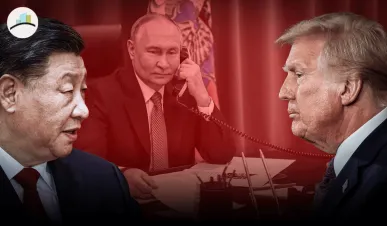
Trump Accuses Xi, Kim, and Putin of Conspiring Against the U.S. – The Shocking Claim That Could Change Global Politics
In a stunning revelation today, former President Donald Trump accused Xi Jinping, Kim Jong-un, and Vladimir Putin of conspiring against the United States during a high-stakes Beijing meeting. This bold claim has sent shockwaves through political circles around the world, sparking intense speculation about what these global leaders are plotting, and what it could mean for U.S. foreign policy moving forward.
This is not just another round of political rhetoric—it’s a game-changing accusation that could have far-reaching implications. Trump’s statement has opened a Pandora’s box of questions: What are these leaders planning? How does this affect the global balance of power? And what does this mean for the future of international relations?
MORE ARTICLES:
Trump’s Bold Statement: What Did He Actually Say?
During his meeting in Beijing, Trump made one of the most provocative claims of his political career: Xi, Kim, and Putin are conspiring against the U.S.. According to Trump, these three world leaders have been working in tandem to weaken the United States’ global influence. He pointed to several recent actions taken by China, North Korea, and Russia that, in his view, were designed to undermine the U.S. economy, national security, and military dominance.
Trump specifically pointed to Xi’s expansionist policies, Kim’s nuclear provocations, and Putin’s military aggression in Ukraine as clear signs that these leaders are coordinating their efforts to destabilize the U.S. and its allies. He framed this as a dangerous alliance that has been building behind closed doors, and now, it’s out in the open.
Why Does This Matter?
Trump’s accusations have put international relations under the microscope. If there’s any truth to his claims, it could lead to unprecedented tensions between the U.S. and some of the world’s most powerful nations. The potential for trade wars, military confrontations, and political instability has never been higher. So, what does this mean for the global order?
Could Trump’s revelations lead to an all-out international conflict? Or is this merely a high-stakes political maneuver aimed at shoring up Trump’s image as the strong, tough leader America needs to combat rising global threats?
What’s at Stake: Global Politics in the Balance
This accusation isn’t just about Trump pointing fingers—this is about a fundamental shift in how the U.S. perceives its role on the world stage. If the United States believes that Xi, Kim, and Putin are truly plotting against it, this will drastically alter the foreign policy landscape. The Biden administration has already faced challenges in managing U.S. relations with these countries, but Trump’s accusations could force a complete reassessment of U.S. strategies.
If this claim is taken seriously by lawmakers and diplomats, we could see increased military presence in key regions like the South China Sea, Eastern Europe, and the Korean Peninsula. There could be a stronger military buildup and economic sanctions aimed at isolating these leaders. The U.S. and its allies might even form new alliances to counteract this trio’s influence.
The Global Economic Fallout
The economic ramifications of Trump’s accusations could be severe. If these three nations are seen as actively working to destabilize the U.S. economy, it could lead to massive trade disruptions and global market shocks. Countries might start shifting trade routes, and alliances could be tested as the world scrambles to react to the growing tensions.
Global markets are already volatile, and if these accusations turn into concrete actions, it could create a ripple effect that shocks the financial world. Investors will likely react with caution, and stock markets could face major dips as the threat of global conflict looms closer.
The Ripple Effect: What Will Happen Next?
Trump’s explosive claims could spark a realignment of global power. If Xi, Kim, and Putin are seen as uniting against the U.S., it could push countries that are currently neutral to pick a side. Will nations like India, Brazil, and Turkey align with the U.S. in defense of democratic values? Or will they opt for economic relations with China, Russia, and North Korea?
This will create new alliances, where the U.S. and its traditional allies might be forced to take a stand against a unified China-Russia-North Korea front. How these alliances unfold will be critical for the next decade of international diplomacy.
Trump’s Political Agenda: What Does This Mean
Trump’s accusations are also likely a strategic move to bolster his presidential campaign. By portraying himself as the only leader capable of confronting global adversaries like Xi, Kim, and Putin, he’s positioning himself as the strong leader America needs in an increasingly unstable world.
As we head into the next presidential election, this bold claim could define the debate on national security and foreign policy, shaping Trump’s narrative as the candidate who will protect American interests from foreign interference.



