
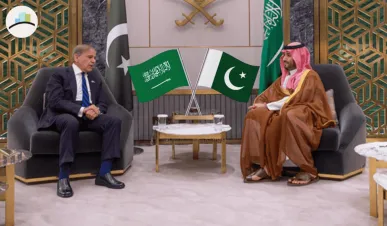
In an unprecedented move that’s sending shockwaves across the global security landscape, Pakistan and Saudi Arabia have signed a historic defense pact that is poised to fundamentally alter the balance of power in the Middle East. This groundbreaking deal, years in the making, is set to reshape the region’s geopolitics and military alliances in ways that could have long-lasting global implications. As tensions continue to rise in the Gulf, this agreement may mark the beginning of a new era of strategic military cooperation between the two nations—but what does this truly mean for the future of the Middle East and the world?
Why Is This Pact Creating So Much Buzz?
The defense pact between Pakistan and Saudi Arabia isn’t just a standard military agreement—it represents a seismic shift in the way power structures are being shaped in the Middle East. The world is watching, and for very good reason. Saudi Arabia, a heavyweight military power in the Gulf, and Pakistan, a key regional military giant with a longstanding defense legacy, have now united in a way that will have profound and far-reaching consequences for both countries and the region at large.
This deal signals an unprecedented level of cooperation and alliance between the two nations—one that could serve as a counterbalance to the increasing geopolitical instability of the region. From economic and security dynamics to military power projections, this pact is not just a defensive agreement; it’s a strategic partnership aimed at reshaping the entire Middle Eastern geopolitical environment.
MORE ARTICLES:
A Revolutionary Military Alliance: What’s at Stake?
Joint Military Exercises and Collaboration
At the core of this historic defense pact lies a commitment between Pakistan and Saudi Arabia to regularly conduct joint military exercises. These exercises will not only enhance the operational readiness of both countries' armed forces but will also ensure that they are prepared to face emerging security threats head-on. This partnership is about practical defense, ensuring both countries have the ability to respond in real-time to any crisis or threat that may arise in the volatile region. The focus will be on counter-terrorism operations, defensive strategies, and border security, which are essential to protecting their sovereignty and strategic interests in the Gulf.
Moreover, these exercises will serve as an opportunity for Pakistan and Saudi Arabia to refine their cooperative military tactics, ensuring a seamless military response should the need arise. In a region fraught with instability, a joint military front of this magnitude is a significant force multiplier.
Technology and Intelligence Sharing
In addition to joint military drills, the defense pact lays the groundwork for unprecedented levels of intelligence sharing between the two countries. This aspect of the deal is particularly important in the fight against terrorism and regional instability, which have plagued the Middle East for decades. Pakistan, with its military intelligence capabilities honed over years of counter-insurgency efforts, will share crucial intelligence with Saudi Arabia, while the latter offers its cutting-edge technology in military surveillance, cybersecurity, and advanced weaponry.
The partnership could open the door for both nations to significantly enhance their surveillance operations, cyber defense capabilities, and counter-terrorism measures. This is a dynamic that could shift the power dynamics not only in the Middle East but also in how global powers view and engage with the region. Together, Pakistan’s vast intelligence network and Saudi Arabia’s advanced military technology could become an unmatched force in the region, making this pact a powerful tool for counteracting emerging threats.
A Unified Military Front
Perhaps the most important takeaway from this historic defense pact is the creation of a military axis between Pakistan and Saudi Arabia. This alliance is designed to project power, enhance regional security, and counterbalance adversaries who may seek to destabilize the Gulf region. Saudi Arabia, long seen as a dominant force in the Middle East, has aligned itself with Pakistan to ensure that it maintains its position of power, while Pakistan benefits from the immense military resources of Saudi Arabia.
This partnership will likely serve as a counterweight to the growing influence of regional powers like Iran, whose increasing military presence in the region has been a source of concern for both countries. The partnership could also serve as a strategic hedge against other regional powers looking to expand their sphere of influence in the Middle East.
What’s the Bigger Picture?
This military cooperation between Pakistan and Saudi Arabia is not happening in a vacuum. The Middle East is a region characterized by complex alliances, rivalries, and mounting tensions. Countries like Iran, Yemen, and Turkey are all involved in a larger geopolitical struggle for power. In this context, the Saudi-Pakistani partnership becomes a strategic move to address the challenges posed by Iranian influence, terrorism, and instability in neighboring countries.
The Gulf states, in particular, are facing escalating threats, and the growing instability in places like Yemen, where Saudi Arabia has had military involvement, underscores the need for stronger regional defense alliances. The Saudi-Pakistani defense pact could become the cornerstone of a new regional defense strategy, with these two countries at the helm.
The Fallout: Who Else Is Watching?
This deal is generating waves far beyond Islamabad and Riyadh. Regional powers and even global superpowers are now forced to re-evaluate their own military and diplomatic strategies in the wake of this pact. The implications of this partnership go far beyond bilateral relations—it could lead to a restructuring of military alliances across the globe.
India’s Response
As Pakistan’s neighbor, India will undoubtedly be watching this development closely. India has longstanding ties with Saudi Arabia, and the strengthening of Pakistan-Saudi Arabia military ties could lead to shifting security dynamics in South Asia. India, with its own strategic interests in the Gulf, may need to adjust its defense policies in response to this growing alliance.
Iran’s Perspective
Iran, another key regional player, could perceive this Saudi-Pakistani alliance as a direct challenge to its influence in the region. Tehran has long sought to assert its dominance in the Gulf, and the formation of this defense pact could lead to a further deepening of regional divisions. Iran may seek to counter this partnership through alternative alliances or military posturing of its own, increasing the risk of escalating tensions in the region.
Global Superpowers’ Reaction
The United States and China, both of whom have significant interests in the Middle East, will also be keeping a close eye on this evolving partnership. The U.S., with its longstanding ties to Saudi Arabia, may welcome the deal as a way to strengthen its own military presence in the Gulf, especially in countering Iran. On the other hand, China, which is investing heavily in the region through the Belt and Road Initiative, could view this new military alliance as a challenge to its own interests and strategies in the Middle East.
The Strategic Importance of This Pact for Saudi Arabia and Pakistan
For Saudi Arabia, the partnership with Pakistan provides added military support in the face of ongoing regional conflicts. As Saudi Arabia navigates complex military involvements in Yemen and other parts of the Gulf, this partnership will ensure it has a reliable ally with significant military capabilities. Furthermore, Saudi Arabia gains access to Pakistan’s military expertise, particularly in areas like counter-terrorism operations and border security.
For Pakistan, the agreement provides access to Saudi Arabia’s vast military resources and funding, which could enable Pakistan to modernize its own armed forces and gain critical defense contracts. With the security situation in the Middle East becoming more unpredictable by the day, this alliance offers Pakistan a unique opportunity to expand its influence and secure long-term military cooperation with one of the region’s most powerful states.
The Future of the Middle East: What Happens Next?
As the Saudi-Pakistani military pact gains traction, it sets the stage for unpredictable outcomes. Will other regional powers join this growing alliance? Could this lead to the creation of a new military bloc that rivals existing alliances in the Gulf and beyond? And what impact will this pact have on global security dynamics?
Only time will tell how far this partnership will go, but one thing is certain: the Middle East’s future is more uncertain than ever. Pakistan and Saudi Arabia are positioning themselves to lead a new chapter in regional defense, one that could fundamentally alter the balance of power in the Middle East and across the globe.



