
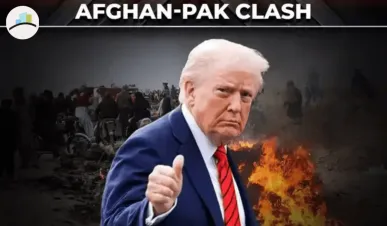
'Pak Attacked Afghanistan': Trump Speaks Out on His Peace Role
Tensions between Pakistan and Afghanistan have once again reached a boiling point after Pakistan launched a military attack on Afghanistan, intensifying the already fragile relationship between the two nations. In the wake of this escalation, former President Donald Trump has spoken out, reflecting on his role in attempting to broker peace between the two countries. With violence continuing to destabilize the region, Trump’s comments shed light on his diplomatic efforts and the challenges of achieving peace in a region plagued by years of conflict.
In a candid interview, Trump discussed his administration’s efforts to mediate between Pakistan and Afghanistan, acknowledging the difficulties involved but also expressing a sense of hope that diplomacy could still prevail. As both nations remain locked in a complex and often contentious relationship, Trump’s reflections are more relevant than ever in understanding the delicate balance required to avoid further bloodshed and create the foundation for a lasting peace.
MORE ARTICLES:
The Escalating Tensions: What Led to Pakistan's Attack on Afghanistan? 🇵🇰🇦🇫
The recent attack by Pakistan on Afghanistan has once again put the spotlight on the volatile situation in the region. This attack, which targeted Afghan military positions along the border, is the latest in a series of confrontations that have plagued both countries for years. Afghanistan’s government was quick to condemn the aggression, calling it a blatant violation of its sovereignty and an attack on its national security.
The history between Afghanistan and Pakistan is fraught with tension, often revolving around territorial disputes, the presence of militant groups, and the broader geopolitical interests of both countries. In particular, the region along the Afghanistan-Pakistan border has been a flashpoint for violence, with both sides accusing each other of harboring militants. Pakistan’s military offensive is seen as a response to what it perceives as Afghanistan's failure to control these groups, but it has only fueled further animosity between the two nations.
For Afghanistan, this attack represents more than just a military assault; it underscores the ongoing struggle for stability in a region that has been rocked by decades of war and political instability. The Afghan government, led by President Ashraf Ghani, has called for immediate international intervention, urging global powers to step in and hold Pakistan accountable for its actions.
Trump's Perspective on Peace Efforts: A Candid Reflection on Diplomacy
In his comments, Trump shared insights into his administration’s approach to diplomacy and peacebuilding in Afghanistan. Reflecting on the peace talks that took place under his leadership, Trump emphasized the critical role the United States played in facilitating dialogue between Afghanistan and Pakistan. Trump noted that he had made significant strides in getting the leadership of both countries to sit down together, despite the longstanding mistrust and hostility between them.
According to Trump, the U.S. government used its leverage to encourage both Afghanistan and Pakistan to engage in talks, something that had been elusive for many years. "It’s never easy to bring two countries that have fought for decades into a room together," Trump remarked. "But we had to do it, because if peace was ever going to happen, it needed to come through a diplomatic resolution, not through more bloodshed."
He acknowledged that while his peace efforts didn’t completely resolve the conflict, they set the groundwork for continued negotiations. The idea was always to build trust incrementally, starting with small agreements and building towards a more comprehensive peace deal. For Trump, the U.S. role was clear: the country had a responsibility to act as a mediator and ensure that both Afghanistan and Pakistan understood the long-term consequences of ignoring diplomatic solutions.
Afghanistan's Struggle for Peace: A Long Road Ahead
While the diplomatic efforts made during Trump’s presidency were significant, the Afghan government continues to face immense challenges in its quest for peace. The recent attack by Pakistan only adds to Afghanistan's already heavy burden, as it tries to maintain control over its borders and mitigate the threat posed by insurgent groups. The Afghan government has made it clear that it will not tolerate further violations of its sovereignty, but the question remains: can peace ever be fully achieved?
The Afghanistan-Pakistan border region has long been a source of tension, not only because of the military confrontations but also due to the complex web of alliances and rivalries involving various militant groups. Afghanistan accuses Pakistan of providing safe havens to Taliban fighters, a claim that has been a source of significant tension. On the other hand, Pakistan argues that Afghanistan is harboring militants targeting Pakistan’s security. The blame game continues, but both sides have to realize that they cannot continue down this path of endless conflict.
For Afghanistan, the ultimate goal is to achieve lasting peace and stability, something that remains elusive in a country still reeling from years of war and foreign occupation. The attack from Pakistan has only highlighted the fragility of the situation. However, the Afghan people remain resilient, and their government continues to seek international support, hoping to break the cycle of violence.
Trump's Legacy and the Path Forward: Can Diplomacy Break the Cycle?
As Trump reflects on his time in office, he remains optimistic that diplomacy can still pave the way for peace in the region, even though the obstacles are immense. The former president emphasized that the only way forward is through dialogue and cooperation. "It’s not easy, and it doesn’t happen overnight," Trump stated, "but the alternative is far worse—a never-ending war that will tear the region apart."
While some critics argue that Trump’s peace efforts didn’t go far enough, others believe that his approach laid the groundwork for future negotiations. The challenge for both Afghanistan and Pakistan now is to embrace diplomacy as a long-term solution, rather than turning to military action at every turn. Trump’s comments are a reminder that, while the road to peace is complicated, it is not an impossible one.



