
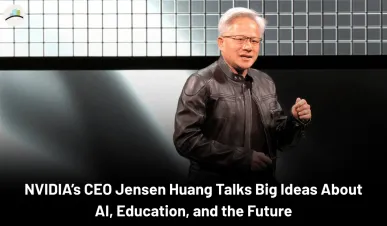
Jensen Huang, CEO of NVIDIA, has been making some bold moves lately and sharing big thoughts on where AI is headed, how education plays into it, and how his company is planning to stay ahead. If you haven’t been paying attention, now’s the time to start—his latest comments aren’t just about tech. They’re about how we, as a society, need to rethink what we teach young people, and the future role of AI in solving huge problems.
Nvidia's CEO Jensen Huang: China has world-class algorithms and AI#Nvidia #algorithm #AI pic.twitter.com/ZCWvhBPWGo
— CGTN (@CGTNOfficial) July 17, 2025
Huang’s Take on the Future of AI
So, if you’ve heard of NVIDIA, you probably know it as the company that makes those powerful GPUs used in everything from gaming to advanced AI. But what Huang’s really excited about these days is generative AI. This is the tech that’s behind the tools that can create things like images, videos, and even entire pieces of music or software, just by being trained on massive amounts of data.
It’s honestly pretty mind-blowing when you think about it. Technologies like AlexNet were huge game-changers in the AI world, and now, NVIDIA’s working on taking it to the next level. It’s like we’re just scratching the surface of what AI can do, and Huang believes that generative AI could change everything, from the way we create content to the way we live and work.
The Importance of Physical Sciences in Education
What really stood out in Huang’s recent comments was his call for students to focus not just on computer science but on physical sciences. You’d think that AI is all about software and algorithms, right? But Huang argues that if we want to truly push AI forward, we also need people who understand physics, engineering, and other hard sciences.
It might sound a little out there, but honestly, it makes sense. If AI is going to solve real-world problems—like climate change, building better robots, or even creating smarter cities—we need to understand the laws of the physical world. Without that knowledge, we’re kind of just building things based on guesses.
More Articles:
What This Means for NVIDIA and Its Investors
Now, here’s where it gets really interesting. Huang’s focus on education and the future of AI isn’t just about making grand speeches—it’s part of a bigger strategy for NVIDIA. The company is making massive investments in next-gen AI, and it’s already paying off. Investors are noticing, and NVIDIA’s stock is on the rise, largely because people believe that Huang’s vision is spot on.
As more industries start using AI for everything from healthcare to autonomous cars, NVIDIA’s GPUs and software are becoming even more crucial. What Huang is saying isn’t just about making NVIDIA a more profitable company—he’s talking about shaping the future of technology, and investors seem to agree that he’s the right person to lead that charge.
Education and Innovation: A Key to the Future
The big takeaway from all of this is Huang’s point about education. He’s saying that, in order to create the next big breakthrough, we need to rethink how we prepare students. Right now, a lot of schools focus mainly on teaching software development, which is obviously important. But Huang believes that without a strong foundation in physical sciences, we’re limiting the kinds of problems AI can solve.
I think that’s a really powerful statement. It’s not just about coding and algorithms—it’s about understanding the universe itself. The future of AI depends on people who can look at the world in a totally new way, from a physics perspective, and figure out how AI can be applied to solve complex, real-world issues.
Looking Ahead
So, what’s next for NVIDIA? Well, it seems like the company is positioning itself not just to be a leader in tech but also to play a major role in how AI develops in the coming years. With Huang pushing for a broader focus on education and pushing boundaries with generative AI, the future looks incredibly exciting.
If you’re a student or just someone thinking about what to study, Huang’s advice should definitely make you think. The future of AI and tech is all about blending different fields of knowledge—software, physics, engineering, and more—and creating the next generation of innovators who will tackle the world’s biggest challenges.
As for NVIDIA, Huang and his team are ready to lead the way, and it looks like we’ll be seeing a lot more of them in the future. They’re not just thinking about the next product launch—they’re shaping the future of AI and how it will impact all of us.



