
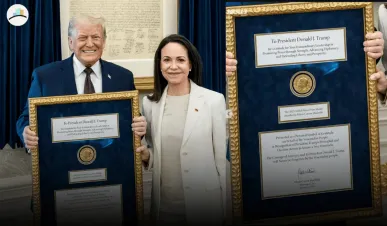
In an unprecedented gesture that has stirred considerable debate, Venezuelan opposition leader Maria Corina Machado recently presented her Nobel Peace Prize medal to former US President Donald Trump during a meeting at the White House. The move, which many describe as symbolic and highly personal, has raised questions about the propriety of transferring such an esteemed award, challenging the norms of international diplomacy and the Nobel Peace Prize’s status as a global recognition of peacebuilding efforts.
The Gesture: What Happened During the White House Meeting?
On January 16, 2026, Maria Corina Machado, a prominent Venezuelan politician and human rights advocate, made headlines when she handed her Nobel Peace Prize medal to Donald Trump in a highly symbolic act during a meeting in the White House. According to sources close to the event, Machado, who had been awarded the prestigious medal in 2025 for her dedication to democratic ideals and standing up against authoritarian regimes, insisted on presenting it to Trump. The moment was deeply personal, reflecting Machado’s admiration for the former president’s stance on Venezuela and his relentless fight against authoritarianism in Latin America.
María Corina Machado of Venezuela in the Oval Office, during which she presented the President Trump with her Nobel Peace Prize in recognition and honor.
— Der Klös (@Life_s_a_gas) January 16, 2026
But it was a fake medal and he didn't realize it.#Trumpisforsale pic.twitter.com/wDknXHQCNe
During the meeting, Trump reportedly accepted the medal, noting it was “a wonderful gesture” and expressing his appreciation for the symbolic act. The event, which took place against the backdrop of tense relations between the US and Venezuela, also attracted global media attention due to the unusual nature of the presentation. In the past, Nobel Peace Prizes have been awarded for efforts in diplomacy, humanitarian work, and conflict resolution, making the gesture of transferring it a rare and controversial move.
Why Did Machado Choose to Present the Nobel Peace Prize Medal to Donald Trump?
The question on everyone’s mind is: why would Maria Corina Machado choose to hand over such a prestigious medal to a former US president known for his controversial foreign policy? For many, the explanation lies in the strong alignment between Trump’s policies towards Venezuela and Machado’s own mission.
Machado, who has long opposed the regime of Venezuelan President Nicolás Maduro, sees Trump’s policies—particularly his sanctions on Venezuela and support for Venezuelan democracy—as a direct extension of her own efforts to challenge authoritarianism in her country. Machado has been vocal in her admiration for Trump’s bold stance on global democracy and human rights, and in this gesture, she likely aimed to underscore her belief that Trump’s influence played a critical role in mobilizing international support for the Venezuelan cause.
The symbolic nature of the transfer could also reflect Machado’s frustration with the international community’s failure to act more decisively against Maduro’s regime. By giving Trump the medal, Machado could be seeking to draw attention to the importance of continued political pressure against autocratic governments and reinforcing her commitment to the struggle for democracy in Venezuela.
Can Nobel Peace Prizes Be Transferred? The Legal and Ethical Questions
While the gesture was undoubtedly symbolic, it raises the significant question of whether Nobel Peace Prizes can truly be transferred or passed on. According to the Nobel Foundation’s rules, the Nobel Peace Prize is awarded to an individual or organization based on their merits and contributions towards world peace. However, there is no official provision that allows the recipient to transfer their medal or prize to someone else.
Critics argue that such a transfer undermines the integrity of the Nobel Peace Prize as an institution. The Nobel Prizes, including the Peace Prize, are meant to honor individuals or organizations for their personal achievements in areas like humanitarian work, diplomacy, and conflict resolution, not as tools for political messaging. In this light, some view Machado’s presentation of the medal to Trump as a political stunt, designed to align Trump’s legacy with the ideals of peace and democracy, despite the criticisms his presidency faced on various fronts.
On the other hand, supporters of the gesture argue that Machado’s act is symbolic of a shared vision for a democratic future for Venezuela and a recognition of Trump’s support for anti-authoritarian efforts in Latin America. By transferring the medal, Machado could be attempting to bridge the gap between international diplomacy and grassroots resistance movements, portraying Trump’s policies as being aligned with her long-standing fight for Venezuela’s freedom.
How Did Trump React to the Nobel Peace Prize Medal Presentation?
Upon receiving the Nobel Peace Prize medal from Machado, Donald Trump expressed his appreciation, calling it a “wonderful gesture.” Trump, whose policies have been criticized for their often combative approach to international relations, accepted the medal in a way that emphasized his ongoing commitment to confronting authoritarian regimes worldwide. His acceptance of the medal without hesitation suggests a continued desire to align his legacy with the promotion of democracy and human rights, especially in regions like Latin America.
However, Trump’s reaction also underscores his complex relationship with the international community. While he has been praised for his strong stance against authoritarian regimes, his own policies—particularly regarding immigration and international diplomacy—have drawn significant criticism. The act of receiving the medal thus adds another layer to Trump’s global image, raising questions about how his legacy will be shaped in the coming years.
The Global Reaction: What Are Experts Saying?
The presentation of the Nobel Peace Prize medal to Trump has generated widespread reactions from the international community. Some political analysts view the gesture as an important moment in the ongoing political battle for Venezuelan democracy, while others express concern that it diminishes the significance of the Nobel Prize.
According to international law experts, there’s no precedent for the transfer of a Nobel Peace Prize, and they stress that such actions could set a dangerous precedent if political figures start handing out such awards based on alliances rather than merit. Critics have also pointed to the fact that Trump’s presidency was marked by tensions with international organizations, making the act of accepting the medal seem even more controversial.
However, proponents of the gesture argue that it highlights the potential for unconventional diplomatic efforts to achieve change. They emphasize that Machado and Trump share common ground on the issue of confronting authoritarianism and that this moment should be seen as a symbolic recognition of shared democratic values rather than a literal endorsement of each other’s political careers.
Conclusion: What Does This Mean for the Future of the Nobel Peace Prize?
Maria Corina Machado’s presentation of her Nobel Peace Prize to Donald Trump will likely be remembered as one of the most unconventional moments in the history of the prestigious award. While the transfer of a Nobel Peace Prize medal may have little legal weight, its symbolic significance cannot be ignored.
The incident raises important questions about how political symbolism can intertwine with established institutions like the Nobel Prizes. As the world watches, this gesture may open up new avenues for diplomatic symbolism and challenge the boundaries of traditional peace efforts. It also reflects the polarizing nature of international politics, where figures like Trump and Machado can find common ground on certain issues, despite their stark differences on others.



