
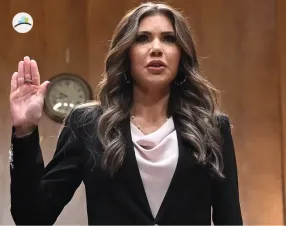
In a tense Senate hearing held on May 20, 2025, Homeland Security Secretary Kristi Noem made a striking claim — asserting that the U.S. president has constitutional authority to suspend habeas corpus in order to remove immigrants from the country during times of border crisis. The statement, made during high-level immigration policy discussions, quickly drew fire for its inaccuracy.
Habeas corpus, a foundational principle embedded in the Constitution, serves as a safeguard ensuring that any individual detained by the state has the right to challenge the legality of their detention in court. It does not, as Noem suggested, empower the executive branch to bypass judicial oversight in deportation proceedings.
Legal Repercussions and Historical Context
Her remarks were immediately challenged by Senator Maggie Hassan (D-NH), who emphasized the importance of protecting civil liberties, particularly in moments of national tension. Legal scholars also weighed in, warning that misrepresenting constitutional powers can set dangerous precedents.
Suspension of habeas corpus is rare in U.S. history and constitutionally constrained. The last widely recognized suspension occurred during the Civil War under President Abraham Lincoln, and even then, it was met with significant legal scrutiny. The Constitution permits suspension “in cases of rebellion or invasion,” and traditionally, only with Congressional approval.
Political Implications
Noem's statement comes amid the Trump campaign’s escalating rhetoric on immigration enforcement. With policy architect Stephen Miller calling for “war-time authority” at the southern border, there is rising concern that such statements are designed to test the legal boundaries of executive power.
Analysts suggest that this strategy is aimed at galvanizing a political base frustrated by what they perceive as lax immigration enforcement. However, critics argue that invoking constitutional suspensions without factual grounding can endanger democratic norms and lead to erosion of checks and balances.
The Bigger Picture: Constitutional Literacy
Beyond the immediate backlash, the exchange has reignited national discourse about the importance of constitutional literacy among top officials. When leaders misstate foundational legal principles, it not only confuses public understanding but risks undermining rule-of-law protections that are essential to democratic governance.
What Lies Ahead?
With immigration expected to be a major issue in the 2024 election cycle, experts are calling for greater clarity and responsibility in public statements made by government leaders. Whether Noem’s statement was a mistake or a calculated political move, its impact on the national conversation around civil liberties and executive power is undeniable.
External Source:
Kristi Noem Calls for Suspension of Habeas Corpus in Immigration Crackdown