
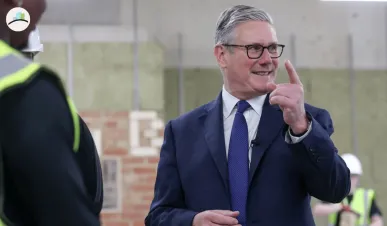
Keir Starmer's Labour Revolt Is Now a Bond Market Crisis UK Borrowing Costs Hit Highest Since 2008
As over 83 Labour MPs demand the Prime Minister's resignation and four ministers quit in a single day, gilt yields have surged to multi-decade highs turning a political rebellion into a financial warning that markets say Westminster has not yet priced in.
The political crisis surrounding British Prime Minister Keir Starmer escalated sharply on Tuesday, May 12, moving from a parliamentary rebellion into a bond market event that has pushed the United Kingdom's borrowing costs to levels not seen since the 2008 financial crisis.
By 11:15 a.m. London time on Tuesday, the yield on the benchmark 10-year UK gilt had jumped 10 basis points to trade at around 5.101%, easing from bigger rises seen earlier in the trading session. Yields on 20-year and 30-year gilts touched their highest levels since 1998.
At least 83 of the total 403 Labour MPs have called for Starmer to step down, according to a tally by the Press Association. That includes four junior ministers who resigned on Tuesday, among them Jess Phillips, who served as Home Office minister, and Miatta Fahnbulleh, junior minister for devolution, faith and communities.
What Triggered the Revolt
The crisis was triggered by the Labour Party's historic defeat in English local elections on May 8, in which the party lost nearly 1,500 council seats while the hard-right Reform UK party won 1,454 seats across England. The BBC's projected national vote share indicated Labour would receive just 17% of the vote if the local elections had taken place across the whole country nearly half its 2024 general election result, and level with the Conservatives.
Following the result, Starmer appointed former prime minister Gordon Brown and Labour peer Harriet Harman to advisory roles in what was described as an attempt to reset his premiership. However, one Labour MP was reported by the BBC as saying: "Not sure voters in Wigan, Wandsworth, Salford or Sunderland voted Reform because they thought we needed more advisers from a different era of Labour politics."
Other Stories-
-Memphis Grizzlies Star Brandon Clarke Dies at 29, Cause of Death Deferred
-“Fake Address? Unpaid Tax?”: Green Party Leader Zack Polanski Hit by Explosive Houseboat Scandal
-Arcadia Mayor Eileen Wang Accused in Shocking China Influence Scandal, Resigns Immediately
Starmer's Response and the Cabinet Split
On Monday, Starmer delivered a speech taking responsibility for what he described as "very tough" election results but argued that Labour would "never be forgiven for inflicting the chaos of constantly changing leaders" on the country. He told his cabinet on Tuesday that he would "get on with governing," pointing out that no formal leadership challenge had been triggered.
A readout of the cabinet meeting from the UK Cabinet Office contained no mention of the leadership crisis. Secretary of State for Work and Pensions Pat McFadden said afterwards that "no one challenged" the prime minister and that "there were many messages of support." However, Al Jazeera reported that six cabinet members were privately telling Starmer to step down, including Foreign Secretary Yvette Cooper and Home Secretary Shabana Mahmood.
Eurasia Group analysts said Starmer's speech "failed to include enough new policies to satisfy" critics. "Starmer's attempt to quell a rebellion against his leadership has failed," they noted, adding that while he may remain in Downing Street a few more months, "he is still fighting for his political life."
The Bond Market Dimension
What distinguishes this crisis from previous Labour leadership turbulence is the scale of market reaction — and the warning it carries about what comes next.
Strategists at Citi said in a Monday note that a leadership challenge could trigger "a leftwards shift in Labour policies and more expansionary fiscal policy," warning that this would push gilt yields higher and weaken the pound sterling, while also negatively impacting domestic-focused FTSE 250 companies.
Jordan Rochester, head of FICC strategy at Mizuho Bank, described the situation as "Starmer drama" but drew a pointed historical comparison: "This looks more like the Theresa May example where she resigned within weeks of poor local elections in 2019. For many the writing is on the wall at this stage, it's just a matter of how quickly the exit happens."
Neil Mehta at RBC BlueBay warned that if the successor is Angela Rayner or Andy Burnham, "the general reaction from bond markets is not going to be positive," adding that "a Rayner-Burnham ticket with Ed Miliband as chancellor is the City's particular nightmare." The UK already holds the highest government borrowing costs in the G7.
Who Could Replace Starmer
A leadership contest requires the endorsement of 81 Labour MPs 20% of the parliamentary party. Potential challengers include Health Secretary Wes Streeting, former Deputy Prime Minister Angela Rayner, and Greater Manchester Mayor Andy Burnham. Rayner's candidacy is hampered by an ongoing investigation into her tax affairs. Burnham, who polls most favourably of the three, would need to first become an MP.
Eurasia Group assessed the most likely scenario as MPs forcing a leadership election by September, with a 35% probability, followed by a 25% chance of an orderly transition and a 20% probability of an immediate leadership contest.
If Starmer were to be removed, it would mark the first time a sitting Labour Prime Minister has ever faced a leadership challenge or been removed by his own party.



