
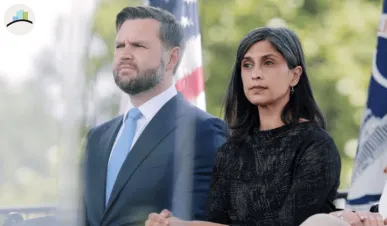
A single moment on stage has blown up into a storm. U.S. Vice President J.D. Vance surprised the crowd when he openly said he hopes his wife, Usha, who comes from a Hindu background, will one day be “moved” by his Christian faith. That remark launched what’s now being called a political and cultural crisis—one that isn’t just about religion, but about strategy, identity and what it means to be electable in modern America.
The moment that triggered the fire
During a talk at a conservative youth event, Vance was asked how he balances his faith with his wife’s background in raising their children. He replied:
“Most Sundays, Usha comes with me to church… Do I hope eventually that she is moved by the same thing I was moved by? Yeah, honestly I do wish that.”
“But if she doesn’t, then God says everybody has free will…”
This public statement—on national stage, in front of thousands—instantly lit a fuse. Critics called it a slap at Usha’s heritage. Supporters say it was a blunt expression of faith.
MORE ARTICLES:
Why the reaction is so intense
-
Interfaith marriage under spotlight: Usha is a Hindu‑raised lawyer of Indian origin, married to Vance in 2014. Her heritage and faith now sit awkwardly at the heart of this controversy.
-
Electability calculus exposed: The remark screams of political calculation—aligning with evangelical Christian voters while risking alienation of minority communities and wives seen as sidelined.
-
Identity battleground: Some Hindu organisations and immigrant‑rights activists say this implies their faith is “lesser” or waiting for conversion — a deeply charged claim in a multicultural democracy.
-
Media and backlash snowball: What began as a remark now dominates headlines, podcasts and social feeds. Vance’s clarification that Usha has “no plans to convert” has done little to quell the uproar.
What’s at stake—beyond one remark
-
Political fallout: Will Christian conservatives rally behind Vance’s openness? Will minority voters recoil at what they see as a tacit rejection of Usha’s background? Election‑season dynamics could shift.
-
Marriage optics: Usha remains largely silent publicly. Her voice, beliefs and image are overshadowed by her husband’s message. Critics ask if she is being used as a prop for political gain.
-
Cultural ripple effects: This isn’t just U.S. politics—it’s about how interfaith couples are perceived, how immigrant‑heritage Americans are treated, and how public figures talk about religion.
-
Media strategy and authenticity test: Vance’s remark forced him to clarify—but the damage is done. The question: Can this be recovered from, or will it be a scar on his future ambitions?
What could this lead to? The possible outcomes
-
Scenario A – Rallying the base: Vance doubles down on his Christian messaging, Christian conservative support spikes, and Usha remains behind the scenes—mission accomplished for the campaign.
-
Scenario B – Broader backlash: Minority communities and moderate voters view the remark as tone‑deaf. Usha’s silence grows louder. Vance faces a credibility gap.
-
Scenario C – The marriage front becomes campaign front: Media turn the story into more than faith—questions of marriage, representation, agency and politics take centre stage. The personal becomes campaign material.



