
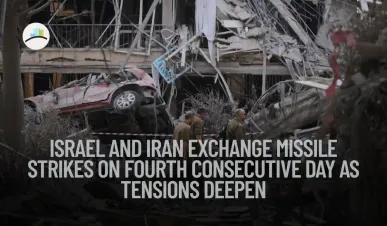
Hostilities between Israel and Iran entered a critical fourth day as both nations carried out missile and drone strikes, causing mounting civilian casualties and increasing fears of a wider regional conflict. The escalation centers on recent Israeli airstrikes in Iran, which Iran has responded to with direct attacks inside Israeli territory.
Swift escalation in civilian impact
Late Sunday into Monday, Iran launched a significant missile and drone assault targeting major Israeli cities, including Tel Aviv and Haifa. At least eight civilians were killed and over 100 wounded in residential neighborhoods, commercial districts, and near a key power plant by Haifa’s port. This surge in violence comes after Israeli strikes earlier in the weekend, which Iranian officials said resulted in more than 224 deaths, primarily of civilians.
More Articles:
Warnings and emergency sirens have become routine in affected cities. In Tel Aviv, missile alerts at 4 a.m. forced residents into shelters while blasts shattered windows in several high-rise buildings. Power supply disruptions were reported at a Haifa plant, highlighting the humanitarian dimensions of the conflict.
Military assertiveness on both sides
Iranian military sources claimed this latest offensive used advanced missile tactics that briefly overwhelmed Israeli defense systems. The Israeli Defense Ministry responded by saying the attack aimed at civilian areas to deter future strikes. Israeli forces reportedly targeted command centers belonging to Iran’s paramilitary Revolutionary Guard.
This represents the most intense direct exchange between the two countries since June 13, codenamed “Operation Rising Lion” by Israel. Since then, both sides have expanded their offensive operations with no immediate signs of de‑escalation.
Diplomatic reverberations
Global and regional powers have increasingly framed this crisis as a central issue in high‑level diplomatic gatherings, including the G7 summit. Leaders are under mounting pressure to prevent broader conflict. European and Middle Eastern nations have encouraged restraint, warning that a prolonged confrontation could disrupt regional stability and global economic ties.
In the US, political tensions are evident: despite support for Israel, President Trump vetoed an Israeli proposal to assassinate Iran’s supreme leader. Meanwhile, US forces have assisted by intercepting some inbound missiles. Governments across Europe and Asia are assessing evacuation plans for their citizens.
Tehran will “pay the price” for its fresh missile onslaught against Israel, the Jewish state’s defense minister warned Monday, as markets braced for a fourth day of ramped-up conflict between the regional powers.
— CNBC International (@CNBCi) June 16, 2025
Read more here: https://t.co/Pz3jNMA8f2 pic.twitter.com/Jb9BtFkImc
Market and strategic implications
The conflict has triggered a modest but noticeable impact on global markets. Oil prices rallied amid concerns of supply disruptions through the Strait of Hormuz. Equity markets, by contrast, remained largely stable. Analysts suggest commodity markets are most vulnerable to further escalation, while equities would react more strongly if military operations spread.
In Israel and Iran, civilian infrastructure and urban areas continue to bear the brunt. Israeli cities are reinforcing shelters and public facilities, while Iran has targeted homes and an oil depot.



