
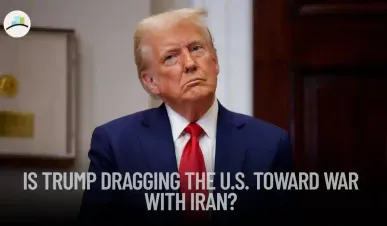
Trump’s ‘Wink to Israel’: Is the U.S. Sliding Into War With Iran?
As Israeli airstrikes batter Iranian military infrastructure and nuclear sites, global observers are fixated on one question: Is the United States under Donald Trump quietly preparing to join the fight?
Despite President Trump’s public messaging favoring diplomacy—most recently via Truth Social affirmations—his administration's recent actions and timing of statements raise critical questions about the real U.S. stance on the Israel-Iran conflict. Analysts now warn that America may be inching closer to military involvement, even if not officially acknowledged.
The Unofficial Nod: Trump’s Strategic Ambiguity
Trump’s dual-track messaging—urging a deal on one hand while signaling imminent danger on the other—has prompted observers to liken his role to giving Israel a “wink and a nod.” While Trump denied prior knowledge of Israel’s latest assault on Iran’s Natanz facility, his 60-day ultimatum and social media rhetoric—especially the dramatic “Evacuate Tehran!” warning—suggest more than mere coincidence.
Ali Ansari of St Andrews University summed up the sentiment: “Even if the specific timing did surprise them, they must have been aware.”
This echoes a historical pattern: Trump’s foreign policy often leaves room for plausible deniability while creating momentum toward escalation—be it in Syria, North Korea, or now Iran.
What’s Not Being Discussed Enough: The Unseen Calculations
-
Israel’s Preemptive Strike Against Diplomacy:
Experts like Kelsey Davenport argue that Israel feared a diplomatic breakthrough more than Iran’s uranium stockpile. If negotiations led to a softened Iranian stance, it might undercut Israel’s long-standing narrative of existential threat. In this light, Israel’s strike can be seen as not just military, but political sabotage. -
Economic Incentives for Escalation:
U.S. defense contractors stand to benefit from arms sales, especially if Israel seeks advanced U.S. weaponry like the Massive Ordnance Penetrator. Meanwhile, heightened conflict could spike oil prices, favoring domestic energy producers and political allies. -
A Risky Play for Regional Dominance:
For Trump, backing Israel in this conflict—tactically or emotionally—may serve a broader strategic goal: reasserting U.S. dominance in the Middle East, especially after years of diplomatic withdrawal and shifting regional alliances involving China and Russia.
Read More:
Could the U.S. Be Pulled Into War—Even Without Wanting It?
With the USS Nimitz heading to the region and refueling aircraft deployed, the logistical groundwork is being laid. While Trump has not green-lit direct strikes, his past behavior shows a penchant for bold, last-minute decisions—think of the Suleimani assassination in 2020.
The risk here is not full-scale war, but accidental escalation. A misinterpreted signal, a retaliatory strike, or even cyber warfare could lead to entanglement. Already, Iranian-backed proxies in Iraq and Syria have hinted at retribution.
Congress Pushes Back, But Will It Matter?
Senator Tim Kaine’s war powers resolution is a constitutional guardrail—but one with limited braking power. Trump could justify limited military involvement under existing Authorizations for Use of Military Force (AUMFs), as past presidents have done. This legal gray zone makes it difficult for Congress to enforce its authority in real-time.
The JCPOA Legacy: A Broken Deal, A Broken Path
The current crisis traces back to Trump’s 2018 withdrawal from the Iran nuclear deal. By removing diplomatic pathways and offering no clear alternative, the U.S. arguably cornered Iran into further uranium enrichment. In turn, this created a pretext for Israel’s military solution.
Davenport and Nephew emphasize that abandoning diplomacy has paradoxically made Iran’s nuclear ambitions more credible and potentially irreversible.
What’s at Stake Now
-
For Iran: National pride and deterrence capability. A U.S.-Israel coalition might force Iran back to the table, but at what domestic political cost?
-
For Israel: Short-term tactical gain could spark long-term instability or regional war involving Hezbollah and Iraqi militias.
-
For the U.S.: Risk of entrapment, global economic backlash, and further alienation from European allies still backing a diplomatic solution.
Bottom Line: A Moment of Strategic Decision
Trump’s administration is navigating a knife’s edge—balancing electoral optics, strategic alliances, and geopolitical credibility. The ambiguity may be intentional, but history shows that when nuclear ambitions and military provocations collide, ambiguity can be deadly.
The real question is whether this conflict remains a proxy struggle—or becomes America’s next war.



