
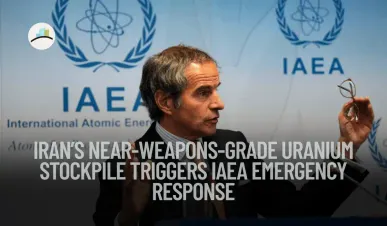
Iran’s urgent expansion of its uranium enrichment capacity has led the International Atomic Energy Agency (IAEA) to convene an emergency session, as the country’s stockpile nears weapons-grade levels. The development comes amid rising tensions, including recent airstrikes that damaged nuclear sites, and may mark a critical turning point in global nuclear diplomacy and Middle East security.
New Nuclear Thresholds in Tehran
Iran has reportedly increased its uranium enriched to approximately 60 percent purity, bringing its stockpile to an estimated 400–450 kilograms. This marks a significant escalation from earlier holdings of around 250 kilograms just weeks ago. While weapons-grade uranium is typically defined as 90 percent pure, reaching the 60‑percent threshold reduces the remaining separation work by more than half.
More Articles:
This accumulation elevates the speed and scale of Iran’s breakout potential. Analysts warn that given the current rate of enrichment and modern centrifuge efficiency, Iran could reach weapons-grade purity within a few weeks—if it chooses to break swiftly.
Inspection Disruptions Linked to Military Action
Simultaneously, recent airstrikes—widely attributed to regional adversaries—targeted above‑ground nuclear sites in Natanz and Isfahan. These operations damaged uranium conversion facilities and disrupted IAEA monitoring systems. While hardened underground enrichment plants such as Fordow remain intact, the strikes have complicated live tracking of materials and raised questions over transparency.
IAEA staff have reported restricted access to several facilities and evidence of damage to cameras and seals essential to verifying Iran’s inventory. This prompted the agency to escalate concerns through an emergency board meeting. Inspectors emphasize that without reliable data, the agency must increasingly rely on modeling and sampling—an imperfect substitute for real-time oversight.
You lie so easily and carelessly.
— Yehuda Teitelbaum (@chalavyishmael) June 5, 2025
In a confidential report seen by the BBC, the International Atomic Energy Agency (IAEA) said Iran now possesses over 400kg of uranium enriched to 60% purity - well above the level used for civilian purposes and close to weapons grade. pic.twitter.com/81c9A3kbc8
Far‑Reaching Diplomatic and Security Impacts
The stockpile nearing 60 percent purity—combined with damaged oversight infrastructure—ramps up international tensions in several ways:
-
Shift in Global Nuclear Strategy
With Iran closer to the final enrichment steps, global powers may reconsider current diplomatic approaches. Whether through renewed sanctions or reversible measures, the sense of urgency has intensified. -
Israel’s Strategic Calculus
The strikes appear aimed at delaying Iran’s enrichment progress. Israeli analysts argue such strikes could slow the program by months, buying time for diplomatic pressure. However, hardliners in Israel have explicitly warned that further deterioration in Iran’s enriched stockpile could lead to preemptive action. -
Diplomatic Deadlock
With the IAEA emergency meeting underway, both Iran and Western countries may leverage the outcome to solidify negotiating positions. Tehran could use the disruption as a bargaining chip, while Western capitals may push for the reinstatement of broad inspection mandates and renewed participation in nuclear agreements. -
Regional and Maritime Security
The shattered oversight and heightened military posture echo across the Persian Gulf. Insurance firms have ratcheted up risk assessments around shipping lanes, especially the Strait of Hormuz. Regional navies are boosting patrols to prevent potential sabotage or retaliation near oil gateways.
The Stakes Ahead
Discussions in Vienna this week will determine whether the IAEA issues a resolution demanding full restoration of inspections or refers Iran’s case to the UN Security Council. Such actions could prompt fresh sanctions from the United States and Europe, including potential “snapback” penalties under pre-agreed nuclear deal mechanisms.
Externally, global oil markets are already factoring in the risk premium from Persian Gulf unrest. Should access to shipping lanes or nuclear facilities be threatened, crude prices may spike, potentially triggering renewed inflation and forcing central banks to consider delaying interest rate cuts.
Iran now holds a uranium stockpile enriched close enough to weapons-grade to cause deep concern. Coupled with compromised inspection capabilities, this raises the risk that Tehran may quietly forge ahead—or conversely, that adversaries may strike again to halt the advance. The IAEA’s emergency meeting is more than procedural—it’s a flashpoint with consequences for diplomacy, markets, and security.



