
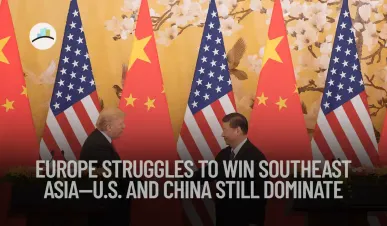
Despite increased diplomatic activity and targeted efforts, Europe’s outreach strategy in Southeast Asia faces uphill challenges. The region proves reluctant to shift allegiances from established powerhouses like the United States and China, exposing Europe’s strategic limitations in the Indo-Pacific.
A nuanced diplomatic push
European leaders have launched the EU’s Indo-Pacific Strategy, establishing regional offices and conducting high-profile visits to countries like Singapore, Vietnam, and Indonesia. These efforts include security dialogues, trade agreements, and investment deals in areas like AI, digital infrastructure, and defense. However, Southeast Asian nations continue to view Europe more as an ancillary partner rather than a strategic counterweight to Washington or Beijing.
U.S. and China retain the initiative
More Articles:
At recent summits, regional leaders noted that U.S.-China rivalry and global supply chain pressures have compelled them toward balancing acts—not loyalty to the EU. This reflects ASEAN’s long-standing preference for strategic autonomy and multipolar relationships.
Europe’s internal fragmentation
Europe’s impact is undermined by fragmented policy approaches across its member states. While France and Germany have pursued independent Indo-Pacific strategies—emphasizing defense ties and commercial outreach—coordination at the EU level remains weak. Southeast Asian observers have raised concerns about blurred priorities and limited follow-through, noting that Europe struggles to translate high-level pledges into sustained engagement.
Where momentum exists
There are signs of progress. France unveiled a suite of cooperation agreements with Vietnam and Singapore—spanning defense, aviation, and critical minerals. The European investment in AI and digital sectors is contributing to a narrative of innovation leadership. The EU’s Global Gateway initiative offers an alternative finance source alongside China’s BRI.
Yet dynamics remain uneven. While Europe excels in soft power, rule-based norms, and institutional support, many ASEAN nations still see it as less agile and less influential than the U.S. or China in delivering speed and scale.
Europe is trying to woo Southeast Asia — but it won’t win it over the U.S. or China https://t.co/zfFfPRBvor
— Caleb McMurtrey (@CalebBMcMurtrey) June 16, 2025
The road ahead
To boost its pivot to Southeast Asia, Europe must:
-
Streamline its policies through a unified EU Indo-Pacific strategy,
-
Scale up tangible investments in high-growth sectors such as AI, semiconductors, and green energy,
-
Align security dialogues with actionable regional engagement—bordering ASEAN’s defense priorities,
-
Maintain persistent presence, leveraging the Asia–Europe Meeting (ASEM) and EU Centres in the region for local influence.
Final thought
Europe’s effort to strengthen its strategic footprint in Southeast Asia is a calculated but long-term endeavor. To compete with the established influence of the United States and China, it must offer consistent, multi-dimensional engagement—beyond diplomacy, into investment, innovation, and security presence.



