
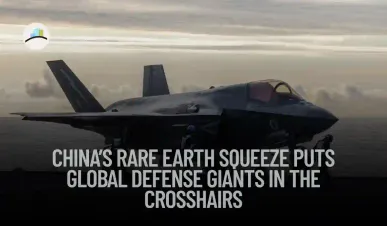
June 10, 2025 | Beijing/Washington D.C. — As geopolitical tensions between the United States and China escalate, Beijing’s tightening grip over rare earth exports is placing mounting pressure on global defense manufacturers who rely on these critical materials for advanced military systems.
Rare earth elements, a group of 17 minerals, are crucial for producing fighter jets, missile systems, radar components, and stealth technology. China accounts for nearly 70% of global production, making it the world's dominant supplier.
Background: Longstanding dependency and strategic risk
For decades, Western nations, including the U.S., have been heavily dependent on China for rare earth supplies due to its vast reserves and low-cost refining infrastructure. The current export curbs follow recent U.S. sanctions targeting China’s semiconductor and defense sectors.
While the official reason cited by Beijing is “resource conservation,” analysts interpret the move as a geoeconomic counterstrike — a form of retaliation in the ongoing technology and trade conflict.
More Articles:
Defense sector faces disruption
Major U.S. defense contractors, including Lockheed Martin, Raytheon, and Northrop Grumman, are bracing for potential supply disruptions. These firms depend on rare earths for components embedded deep within the defense supply chain.
“Rare earths are not just about tech gadgets anymore. They’re at the heart of national security,” said a Pentagon advisor.
The U.S. Department of Defense has already warned Congress that reduced access could delay weapons development timelines and increase costs.
Market and industry reaction
Investors are responding cautiously. Shares of defense companies held steady but displayed increased volatility amid the news. Meanwhile, rare earth miners outside China, including Australia’s Lynas and Canada’s Neo Performance Materials, saw a sharp uptick in share prices.
Western governments are now fast-tracking efforts to diversify supply chains, revive domestic mining, and invest in recycling technologies.
China’s rare-earth mineral squeeze puts defense giants in the crosshairs. https://t.co/KhKicjf46I
— NationalSecurityNews (@NSNWorldwide) June 10, 2025
Next steps and strategic implications
This development has revived calls in Washington to boost rare earth mining and processing in the U.S., reduce strategic dependency, and de-risk supply chains from authoritarian regimes. However, building out domestic capacity may take years and face environmental hurdles.
The EU and Japan are reportedly considering joint investments in rare earth innovation zones to reduce reliance on China.
Source
CNBC – China’s Rare Earth Squeeze Puts Defense Giants in the Crosshairs



