
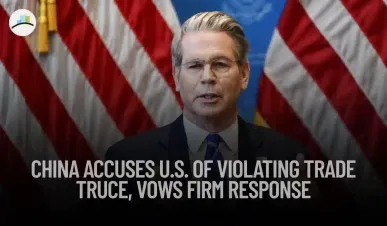
China has sharply accused the United States of violating the recently established trade truce, heightening tensions between the world’s two largest economies. The Chinese Ministry of Commerce condemned Washington for introducing “discriminatory” trade restrictions, including new export controls on advanced artificial intelligence chips and chip design software, as well as visa revocations targeting Chinese students studying technology.
According to China, these unilateral measures undermine the spirit and letter of the Geneva trade agreement signed by both nations last month, which was intended to ease the escalating tariff conflict and promote dialogue. Beijing has promised a “resolute and forceful” response to defend its economic interests and sovereignty.
U.S. Accusations and Reactions
In response, U.S. officials, including President Donald Trump, have accused China of violating the preliminary trade deal by delaying shipments of critical minerals that are vital for American manufacturing and technology sectors. Trump has publicly expressed frustration on social media, accusing China of not honoring its commitments.
Several key figures in the Trump administration have echoed concerns about China’s slow progress. Commerce Secretary Howard Lutnick labeled China’s actions as “slow-rolling” the deal, suggesting deliberate delays. Treasury Secretary Scott Bessent described the current negotiations as “stalled” but expressed hope for renewed talks in the coming weeks.
Also Read:
Impact on Financial Markets and Global Trade
These renewed tensions have triggered volatility across global markets. Asian equities fell amid investor concerns about a potential breakdown in trade relations, while the offshore Chinese yuan weakened, reflecting uncertainty about China’s economic outlook.
Industry leaders and economists warn that any escalation could disrupt global supply chains and dampen economic growth, especially in sectors heavily reliant on trade between the U.S. and China, such as technology, manufacturing, and raw materials.
Diplomatic Efforts and Prospects for Dialogue
Despite the harsh rhetoric, there remains cautious optimism about diplomacy. White House National Economic Council Director Kevin Hassett stated that Presidents Trump and Xi Jinping are expected to engage in discussions soon, although no specific date has been finalized.
Hassett emphasized that trade representatives from both countries continue to communicate daily, aiming to “move the ball forward” in resolving contentious issues and maintaining the Geneva agreement’s framework.
What Lies Ahead for U.S.-China Trade Relations
US-#China trade truce hanging by a thread🧵. Beijing accuses @realDonaldTrump team of actions that “seriously violate” Trump-Xi call on Jan 17 and “severely undermine” Geneva deal with @SecScottBessent @USTradeRep. Claims to have “faithfully” canceled/suspended tariff and… pic.twitter.com/qi3ufMLDGp
— Eunice Yoon (@onlyyoontv) June 2, 2025
The unfolding situation underscores the fragile nature of U.S.-China trade negotiations. Both sides face internal political pressures and economic challenges, making compromise difficult but necessary.
Experts suggest that the outcome of upcoming talks will be critical in setting the trajectory for future trade policies, global economic stability, and technological competition.
As the world watches closely, stakeholders from governments to multinational corporations remain hopeful for a constructive resolution, while preparing for possible disruptions if tensions escalate further.
Source: Bloomberg – China Accuses U.S. of Violating Trade Truce, Vows Firm Response



