
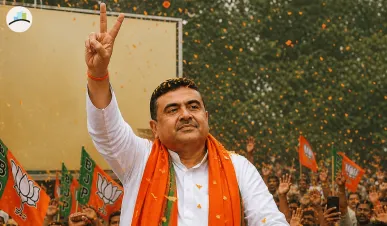
In a momentous political shift in Indian state politics, Suvendu Adhikari was sworn in as Chief Minister of West Bengal on May 9, 2026, at the iconic Brigade Parade Ground in Kolkata. This ceremony marks the first‑ever Bharatiya Janata Party (BJP) government in a state previously dominated by the Trinamool Congress (TMC) under Mamata Banerjee for over 15 years. Thousands of citizens and political dignitaries gathered at the sprawling ground to witness the oath‑taking event.
🚨 Just IN 🚨
— Megh Updates 🚨™ (@MeghUpdates) May 9, 2026
PM Modi arrives at Kolkata’s iconic Brigade Parade Ground for the swearing-in ceremony of the BJP government in West Bengal.
BJP leader Suvendu Adhikari to take oath as the Chief Minister of West Bengal. pic.twitter.com/UOqHyuDZnM
The oath ceremony was more than a formality it symbolises a dramatic political transformation in West Bengal, where the BJP secured a decisive majority in the 2026 West Bengal Legislative Assembly election, winning 207 out of 294 seats and displacing the long‑standing TMC rule.
Brigade Parade Ground: A Venue of Historic Importance
The Brigade Parade Ground, centrally located in Kolkata, was chosen as the site for the swearing‑in due to its vast open space and cultural significance. In recent weeks, the venue was transformed with traditional Bengali artistic backdrops and festive decor reflecting the state’s heritage, underscoring the celebratory mood of the moment.
The ground was also strategically equipped to accommodate the large crowd, with supporters, party workers and onlookers filling the area early in the morning to catch a glimpse of the historic event.
The Oath‑Taking Ceremony: What Happened and Who Was There
The oath‑taking ceremony began mid‑morning, officiated by West Bengal Governor R. N. Ravi, who administered the pledge of office to Suvendu Adhikari as he became West Bengal’s ninth Chief Minister.
Prominent national leaders, including Prime Minister Narendra Modi, Union Home Minister Amit Shah, BJP National President Nitin Nabin, senior Cabinet ministers and Chief Ministers from other BJP‑ruled states were present to lend their support.
The event was also covered live on multiple news channels, and citizens could watch it online through official broadcasts.
What the Ceremony Symbolises for West Bengal Politics
For decades, Mamata Banerjee and the TMC had dominated Bengal’s political landscape, with Banerjee winning multiple terms as Chief Minister since 2011. Her embrace of grassroots politics and connect with the masses made her one of the most influential leaders in eastern India. However, in the 2026 assembly election, she and her party faced a sweeping defeat at the hands of the BJP, signaling a major shift in voter sentiment.
While Banerjee initially resisted resigning after the election results calling the outcomes “forced” and alleging irregularities she was ultimately succeeded by Adhikari following constitutional protocols and the formal government formation process.
The oath ceremony thus marks the official end of the TMC’s 15‑year rule and the beginning of a new political chapter in West Bengal.
MORE ARTICLES:
Political Implications and Public Reaction
The BJP’s victory is widely seen as a major breakthrough for the party in a state historically considered outside its core power base. Political analysts suggest that Suvendu Adhikari’s strong ground‑level campaigning, especially his repeated victories over Mamata Banerjee in key constituencies like Nandigram and Bhabanipur, helped reshape the party’s fortunes.
Thousands of party supporters gathered around the city and at the Brigade Parade Ground to cheer the oath‑taking ceremony, while others stood along streets during a special roadshow by Prime Minister Modi and senior leaders ahead of the main event.
Cultural Touch and Ceremony Details
The backdrop for the ceremony incorporated elements of Bengali culture traditional chalchitra designs and motifs to reflect the region’s artistic heritage, blending political ceremony with cultural symbolism.
Officials also made arrangements for traffic and security around Kolkata, anticipating a large influx of people and high‑profile attendees. Kolkata Police issued detailed advisories to ensure smooth movement and safety during the event.



