
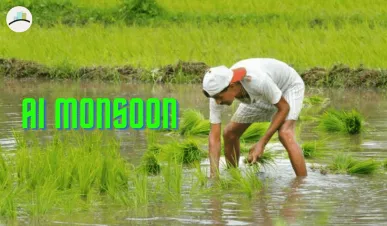
India’s weather forecasting just crossed a scientific frontier. The India Meteorological Department (IMD) has launched a first‑of‑its‑kind, AI‑powered monsoon forecast system that promises highly localized predictions of monsoon onset and rainfall progression up to four weeks ahead, a dramatic upgrade from conventional seasonal forecasts and a potential game‑changer for farmers, disaster planners and millions of citizens who depend on timely rain insight.
A New Dawn for Monsoon Forecasting
For decades, forecasting the Indian monsoon a lifeline for the country’s agriculture and economy has been both vital and elusive. The IMD has traditionally used complex models and statistical approaches to predict monsoon onset and rainfall distribution across broad regions. Now, with artificial intelligence integrated into its forecasting arsenal, India takes a major leap forward.
The new forecasting system blends numerical weather prediction models with AI algorithms, enabling more precise and dynamic predictions that go beyond regional averages and offer block‑level outlooks that were previously impossible.
How the AI‑Enabled System Works
Rather than relying purely on old‑school climate models, the IMD’s new monsoon system uses machine learning and data integration to analyze huge datasets including satellite reads, rain gauge measurements, Doppler radar and historical patterns to forge probabilistic forecasts for up to 4 weeks in advance.
This AI‑enabled model can:
- Predict monsoon onset and progress at block and sub‑district level covering over 3,000 local zones across 16 states.
- Issue rainfall forecasts with 1‑kilometer spatial resolution in pilot regions like Uttar Pradesh, far more detailed than earlier forecasts.
- Update probabilistic rainfall and monsoon trends weekly to assist planning and readiness.
Why This Matters for India
India’s monsoon isn’t just rainy season chatter it’s economic lifeblood. Nearly half of the country’s agricultural land depends on monsoon rains, and rainfall patterns influence everything from crop sowing and harvests to water reservoirs, food prices and disaster preparedness. In years where rainfall falls short, the economy and farmers feel the impact sharply.
By offering hyper‑local, impact‑based forecasts, the new IMD system can help farmers decide when to sow, irrigate or protect crops, alert authorities about flood risks before they hit, and reduce economic losses from poorly timed weather surprises.
MORE ARTICLES:
AI Meets Weather: A Technological Revolution
India isn’t just forecasting weather it’s harnessing cutting‑edge technology to do it. The collaboration between the IMD, the Indian Institute of Tropical Meteorology (IITM) and the National Centre for Medium Range Weather Forecasting (NCMRWF) has yielded this advanced platform, which reflects a broader shift toward impact‑based forecasting meaning forecasts tailored to where people live and work, not just broad maps of rainfall regions.
In effect, this new system doesn’t just tell us if rain might fall — it gives actionable clues about when, where and how much, enabling early decisions by farmers, disaster managers, city planners and citizens alike.
Pilot Projects & What’s Coming Next
The AI‑driven system is already being piloted in chosen regions such as Uttar Pradesh, where rainfall forecasting is happening at a 1‑km grid level. This level of detail vastly outstrips older models that offered only generalized regional forecasts.
Officials say coverage and forecasting detail will expand as the system matures, ultimately encompassing more states and offering an even wider suite of tools to interpret monsoon signals, dry spells, flood likelihood and rain distribution trends.
Monsoon Outlook: Below Normal Rainfall This Year?
This innovation arrives against a backdrop where the IMD’s first stage monsoon forecast for 2026 shows rainfall is likely to be below normal around 92% of the long‑period average, influenced by global climate patterns like El Niño. Although this doesn’t directly tie to the new forecasting system, it highlights why timely, localized insights are now more crucial than ever.
What It Means for You From Farmers to Forecast Followers
The practical impact of this system goes beyond specialized meteorological circles:
- Farmers can plan crops, irrigation and harvests with advanced notice.
- Disaster managers can better prepare for floods or drought outlooks.
- Cities and utilities can anticipate water demand, reservoir levels and heatwave interplay.
- Everyday citizens can get more reliable rain warnings for travel, health and daily life.
This isn’t just weather news it’s decision‑ready monsoon intelligence delivered months before the rain gods arrive.



