
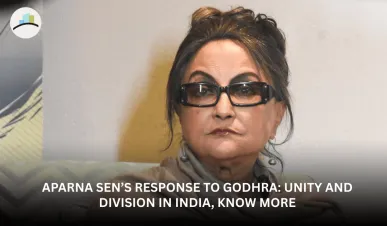
In the aftermath of the Godhra riots of 2002, many artists, filmmakers, and intellectuals struggled to express the deep, painful divide that had gripped the nation. One voice that stood out was Aparna Sen, the iconic Bengali filmmaker and actress. Known for her nuanced storytelling and bold social commentary, Sen's work often reflects the complexities of India's diverse social fabric.
Her film “The Japanese Wife” (2010) and other works have explored themes of love, religion, and identity in contemporary India. But when it came to Godhra, Aparna Sen responded in a way that only she could—through the lens of human emotions, asking the hard questions about India's pluralism, religious divides, and the shared history of its people.
The Setting: A Tamil Brahmin Woman, A Muslim Man, and A Bus Called India
Sen’s response to Godhra was not just limited to the frames of her films. She used art and her platform to reflect on the socio-political landscape of the time. One of her most poignant expressions was in the form of her widely-discussed article published shortly after the violence of Godhra. In it, Sen used the metaphor of a Tamil Brahmin woman, a Muslim man, and a bus called India to explore the fragmented national identity that emerged post-Godhra.
A Tamil Brahmin Woman
Sen’s portrayal of the Tamil Brahmin woman symbolizes India's cultural and religious diversity. Tamil Brahmins have long been part of India's intellectual and artistic traditions, yet the violence at Godhra shattered the very fabric that connected communities like these. The woman, a symbol of India's deep-rooted traditions, suddenly finds herself questioning her place in a country that has become increasingly divided along religious lines.
A Muslim Man
The Muslim man in Sen’s metaphor becomes the unfortunate victim of India’s religious divide. Muslims, who were targeted during the Godhra violence, now face an uninvited marginalization. Sen’s treatment of the character goes beyond mere sympathy—it questions how a community that has contributed so much to India's history, culture, and progress can suddenly become a target due to the political climate.
A Bus Called India
And then, the bus called India becomes the powerful metaphor Sen uses to describe the nation. India is a journey of diverse people, each with different identities, religions, and histories. But what happens when the journey is interrupted by violence and hatred? The bus—representing India—starts to falter, and the passengers within it begin to question their collective destination.
MORE ARTICLES:
Aparna Sen’s Cinematic Reflection on Godhra
Aparna Sen’s response to the Godhra violence went beyond the articles and debates. She channeled her reflections into her films, creating characters that embodied the wounds of a fractured society. In her film, “The Japanese Wife,” Sen explored the themes of love, distance, and cultural divide, much like the divide caused by the events of Godhra.
The film dealt with the complexities of human relationships and questioned the idea of identity in a post-Godhra world. The delicate portrayal of the couple, with their contrasting religious backgrounds and cultural baggage, mirrors the emotional and social divide in India.
Why Is This Important?
Sen’s exploration of the Godhra aftermath goes beyond politics—her work provides a deep, emotional look at how people grapple with their identities in a country that is increasingly polarized. At a time when discussions around religious identity and nationalism have been dominating headlines, Sen’s approach is a reminder that at the heart of every divide is a human being, struggling with loss, confusion, and grief.
This discussion is still relevant today, with the rise of Hindu nationalism and communal tensions, echoing the same questions Sen raised nearly two decades ago. By using personal, relatable stories to explore these broader social issues, she forces us to rethink what it means to be Indian and what it means to coexist.
What Are the Long-Term Consequences of Godhra?
The Godhra riots marked a dark chapter in India’s history, but the way it reshaped Indian politics and society still echoes today. As much as it was an act of violence, it was also an act of polarization, one that ripped apart India’s secular identity.
-
Political Consequences: Godhra gave rise to political movements that used religious divisions as a means to gain power. The rise of Hindutva ideologies can trace some of its roots back to the post-Godhra era.
-
Social Impact: Families, communities, and friendships were torn apart. What was once a shared culture became a fragmented identity, one defined by suspicion and mistrust.
-
Economic Impact: The economic policies that followed, aimed at appeasing particular communities, sometimes left others behind. The divide manifested in business practices and regional politics.
Aparna Sen’s Call for Unity: Can We Heal from Godhra?
Through her cinematic and literary works, Aparna Sen urges viewers and readers to look beyond the divisions of the past. The real question she raises is: can India heal from its wounds and move forward as a unified country? The answer isn’t simple. But by embracing stories of personal loss, shared grief, and reconciliation, Sen offers a path towards healing.
She pushes us to reflect not just on the atrocities of Godhra, but also on the long-term societal impacts—on the families that were broken, the communities that became suspicious, and the individuals who lost their way.



