
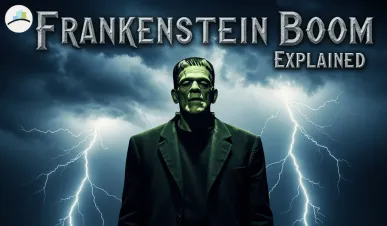
The legendary monster of literature, Frankenstein, has once again captured the world’s imagination. Over the past few days, search trends have exploded with queries like “Frankenstein boom,” “Is Frankenstein real?” and “Where is Frankenstein set?” — signaling a massive resurgence in public interest around Mary Shelley’s gothic creation. But what’s behind this sudden Frankenstein boom, and why are modern audiences so intrigued by a story written more than two centuries ago?
The Frankenstein Boom: A Classic Reborn
Search data shows a breakout trend for the term “Frankenstein boom”, meaning global interest in the creature and its creator has surged by over 5000%. This renewed curiosity could be tied to a number of cultural factors — from upcoming film and TV adaptations to academic discussions around the novel’s timeless themes of science, morality, and creation.
Mary Shelley’s Frankenstein; or, The Modern Prometheus, first published in 1818, remains one of the most influential works in English literature. It tells the haunting tale of Victor Frankenstein, a young scientist who defies nature to create life — only to be horrified by his own creation. The creature’s suffering and humanity, paired with Frankenstein’s guilt, continue to spark debate about ethics in science and artificial intelligence even today.
In an age where humans are building machines that can “think,” the Frankenstein metaphor feels more relevant than ever.
MORE ARTICLES:
Is Frankenstein Real?
One of the top breakout searches is “Is Frankenstein real?”, a question that reflects both curiosity and confusion. The answer — no, Frankenstein was not a real person, but his story was inspired by real scientific curiosity during the 19th century.
Mary Shelley wrote Frankenstein when she was just 18 years old, after hearing discussions about galvanism — a process by which electricity was used to stimulate muscle movement in dead tissue. Scientists of the time believed it might even bring corpses back to life. Shelley used these real scientific experiments to weave her dark and emotional tale of creation gone wrong.
While Frankenstein himself is fictional, the themes of playing god, crossing ethical lines, and the consequences of unchecked ambition remain painfully real — and timeless.
Where Is Frankenstein Set?
The question “Where is Frankenstein set?” has seen a 250% spike in global searches, showing that readers and movie lovers alike want to rediscover the story’s roots.
The novel’s setting plays a crucial role in shaping its gothic tone. It begins in Geneva, Switzerland, where Victor Frankenstein is born into a wealthy family. Later, he attends university in Ingolstadt, Germany, where he conducts his infamous experiments and brings the creature to life. Much of the story’s haunting beauty unfolds across Alpine landscapes, icy mountains, and desolate settings — reflecting the loneliness and despair of both creator and creation.
In the end, the story stretches all the way to the Arctic Circle, where Victor pursues his monster — symbolizing man’s endless chase for knowledge and redemption.
Why Frankenstein Is Trending Now
The Frankenstein boom could be tied to several modern factors:
-
Upcoming adaptations: Hollywood and streaming platforms are rumored to be developing new takes on Shelley’s masterpiece.
-
Halloween nostalgia: The monster remains a pop culture favorite during the spooky season.
-
AI parallels: As artificial intelligence and genetic engineering evolve, Shelley’s warnings about human ambition feel more relevant than ever.
This blend of timeless storytelling and modern relevance has brought Frankenstein back into public conversation — not as a relic of the past, but as a reflection of today’s ethical and scientific dilemmas.
Final Thoughts
From the icy peaks of the Alps to the glowing screens of modern society, Frankenstein continues to haunt and inspire. The recent spike in searches like “Frankenstein boom,” “Is Frankenstein real,” and “Where is Frankenstein set” proves that Mary Shelley’s monster still lives — not in laboratories or graveyards, but in our collective imagination.



