
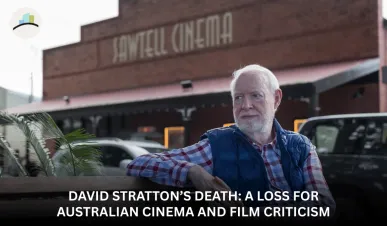
The Legacy of David Stratton: The Loss of a Key Figure in Australian Film Criticism
The death of David Stratton, the esteemed Australian film critic, at the age of 85, marks the end of an era in the world of film criticism. Known for his sharp wit, deep knowledge, and passionate love for cinema, Stratton became an institution in Australia’s film community. For decades, he shaped the way Australians experienced and thought about movies, both at home and on the international stage.
Stratton's contributions extended far beyond merely reviewing films. He was an advocate for Australian cinema, a key voice in the cultural landscape, and a mentor to younger critics and filmmakers alike. His passing has left a void in the Australian film scene, but it also serves as a reminder of the evolving role of film criticism in a rapidly changing media landscape.
Why Is This Important?
David Stratton’s death holds great significance not only for the film community but also for the broader cultural environment of Australia. As one of the longest-serving and most respected critics in the country, his work has had a profound influence on both Australian cinema and international film criticism.
His death highlights the fading tradition of film criticism in an age dominated by social media influencers, user-generated content, and quick reviews. In an era where “likes” and “shares” often hold more weight than thoughtful analysis, Stratton’s approach to film criticism—considered, articulate, and insightful—feels increasingly rare. His passing raises important questions about the future of critical discourse in film and culture at large.
Moreover, Stratton’s close relationship with Australian filmmakers and his advocacy for the local film industry contributed to the growth and international recognition of Australian cinema. He was often a champion of Australian films on the global stage, helping to give them the attention they deserved, and his absence leaves a gap that could affect the visibility of local talent.
What’s Not Being Discussed Enough?
While Stratton's legacy as a critic and journalist is being celebrated, the broader implications of his death are not being discussed enough. For instance, how will Australian cinema continue to receive critical support and recognition without a figure like Stratton to champion it? His advocacy helped elevate Australian directors such as Peter Weir and Gillian Armstrong, and it could be argued that his tireless efforts were instrumental in propelling Australian cinema into the international spotlight.
Moreover, Stratton’s passing signals the potential loss of a certain kind of film criticism. In an age where many critics are embracing digital platforms and shorter, more digestible reviews, Stratton’s approach—thorough, reflective, and deeply personal—serves as a reminder of the value of thoughtful, well-rounded criticism. The questions then arise: Will there be others to take his place in a world that is increasingly obsessed with instant content and viral opinions? Will a younger generation of critics rise to the occasion, or will film criticism continue to be reduced to soundbites?
The Economic and Cultural Implications
David Stratton’s influence extended beyond cinema; he was a key figure in the cultural economy of Australia. The role of film critics in shaping the cultural landscape is often underestimated, but they drive the public’s engagement with films, influencing box office performance, and determining which films gain traction and recognition.
For Australia’s film industry, Stratton’s death also signals a possible shift in the cultural focus of film criticism. The rise of streaming platforms has already altered the traditional cinema-going experience, and with fewer critics like Stratton around to give thoughtful, nuanced reviews, the future of how films are experienced and discussed could look very different. The business of cinema—specifically the relationship between critics, filmmakers, and audiences—may be changing in ways we haven’t fully understood yet.
Additionally, Stratton’s passing is a reminder of the importance of supporting and nurturing local critics. His longstanding relationship with the Australian Film Institute and his presence on public television helped establish a critical framework for understanding Australian cinema, which could be weakened without such figures to anchor the conversation.
Also read on Procapitas
Hidden Risks and Opportunities
The biggest risk associated with the loss of a figure like David Stratton is the potential erosion of thoughtful, in-depth film criticism. As the digital space evolves, film criticism is becoming more fragmented, with influencers often focusing on broader commercial appeal rather than nuanced analysis. While this offers a new form of audience engagement, it also risks watering down the depth of discourse.
However, there is an opportunity here for a resurgence of quality criticism. The void left by Stratton’s departure opens the door for a new wave of critics to step up—critics who are willing to embrace both traditional and modern platforms to offer rich, engaging commentary on films. If anything, Stratton’s legacy might inspire younger generations to approach film criticism with the same passion, care, and attention to detail that he brought to the table.
Historical Parallels: The End of an Era
Stratton’s passing can be compared to the deaths of other cultural figures who helped shape their respective fields. Just as film directors, actors, and musicians have played pivotal roles in shaping the history of cinema, critics like Stratton have also contributed to that legacy, offering valuable insights and shaping public perception. His death is not only a loss to film criticism but also to the entire cultural and historical understanding of Australian cinema.
Much like the passing of influential film critics worldwide—such as Roger Ebert in the United States—Stratton’s departure marks the end of an era for film lovers who relied on his thoughtful critiques to navigate the complexities of cinema. This event also serves as a moment to reflect on how the media landscape has shifted and where the future of criticism lies.
Conclusion: A Legacy That Will Last
David Stratton may be gone, but his influence on Australian film, as well as on global film criticism, will endure. His deep knowledge, commitment to Australian cinema, and personal touch will remain a model for critics and filmmakers alike. His passing serves as a poignant reminder of the irreplaceable role that well-informed, thoughtful criticism plays in the cultural dialogue—and the gap that exists when such voices are lost.
As the film world moves forward, David Stratton’s contributions will continue to be remembered, and his legacy will serve as a blueprint for a future generation of critics and film lovers.



