
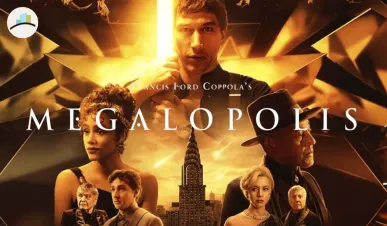
Francis Ford Coppola’s “Megalopolis”: The Gamble of a Lifetime That Could Change Hollywood Forever
In a world dominated by sequels, reboots, and franchise films, few names carry the weight of artistic risk and creative ambition like Francis Ford Coppola. The director, best known for his iconic work on The Godfather trilogy, is once again standing at the precipice of a massive gamble—this time with his self-financed project, Megalopolis. But make no mistake, this isn’t just another movie. It’s a colossal, unpredictable gamble that could either reignite the fire of original cinema or become a cautionary tale for filmmakers daring to push the boundaries. As the documentary Megadoc reveals the truth behind Megalopolis, the question on everyone’s mind is: Will Coppola’s vision pay off, or will this be the biggest disaster in Hollywood history?
The project, which Coppola has poured his own wealth into, is a sci-fi epic set in a future New York City, where society’s cracks begin to show and a battle of ideals unfolds. With a budget that has ballooned far beyond expectations and a production timeline that’s felt endless, Megalopolis has already become a symbol of one director's refusal to compromise. This, however, is not just about a movie. It’s about the future of filmmaking itself and whether a director of Coppola's stature can defy the modern Hollywood system that favors low-risk, high-return formulaic blockbusters over ambitious, original storytelling.
MORE ARTICLES:
Why Is This Happening Now?
At the heart of this crisis lies a larger question: Why would a director of Coppola’s age and stature risk so much? The answer, it seems, is simple—Megalopolis represents not only a passion project but also a last stand for auteur-driven cinema. Coppola, in his 80s, sees this film as his ultimate legacy, a bold return to the kind of cinema that once defined his career. However, the modern landscape of Hollywood, with its focus on franchises and massive profit margins, has made it increasingly difficult for directors like Coppola to pursue their singular visions without external pressure.
Here’s the twist: Coppola is gambling not just with his future, but with Hollywood’s soul. As streaming platforms and big studios continue to dominate, pushing out risky, original content, Megalopolis stands as a lone warrior—a desperate fight against the tide of formulaic content flooding the market. But is the world still ready for this kind of cinema?
What Could This Mean for the Future of Cinema?
Let’s break it down: Megalopolis has the potential to reshape the very fabric of the film industry—or it could become an expensive misstep that marks the end of ambitious, large-scale original films. The question that haunts Hollywood now is: Will Coppola’s gamble pay off, or will it be a cautionary tale of ambition gone wrong?
If Megalopolis succeeds, it could signal a resurgence in original cinema, a reminder that filmmakers can still create world-changing art without the pressure of mass-market appeal. This film could pave the way for more auteurs to take risks, to challenge the blockbuster mentality, and to create art for art's sake once again.
On the other hand, if the film flounders, it might solidify the notion that Hollywood’s financial landscape is no longer built for grand visionaries. A failure could lead to a greater retreat into the world of sequels and prequels, where studios can count on a guaranteed return without taking a chance on untested ideas.
Hidden Risks: What No One Is Talking About
The hidden risk in Megalopolis is that the very factors that make it a passion project—Coppola’s self-financing, the unpredictable scope, the complex narrative—could be its downfall. The budget is soaring into uncharted territory, and with each passing day, the risk grows. Coppola has always been known for taking creative risks, but the financial risk this time is off the charts. Could this film be too far ahead of its time for an audience that’s grown used to digestible franchises?
Moreover, what happens if Megalopolis fails to make a significant impact at the box office? The backlash could reverberate throughout the industry, reinforcing the belief that original ideas cannot succeed in today’s entertainment ecosystem. Studios may become even more averse to large-scale, creative risks, further cementing Hollywood’s shift toward safer bets.
However, there’s another question that is not being discussed enough: What happens if Coppola wins? What if Megalopolis becomes the breakthrough moment for independent filmmakers, showing that visionary cinema can still thrive in a world of diminishing budgets? The repercussions of this success could redefine the industry’s approach to creative freedom, leading to more autonomy for directors to take control of their projects without fear of financial ruin.
The Business of Hollywood: A Cinematic Revolution in the Making
On the business side, the stakes are equally high. The cost of making a film like Megalopolis has raised the question: Are we looking at a shift toward a new type of filmmaking? As the major studios continue to hedge their bets on existing franchises, Coppola’s self-financed project could represent an inflection point—either the dawn of a new era for independent filmmakers or the final nail in the coffin for original storytelling. The economy of cinema itself could change if Megalopolis succeeds, pushing other independent filmmakers to take risks with their own resources. Conversely, if it fails, Hollywood may return to its obsession with high-margin, low-risk franchises that cater to a global audience.
Historical Parallels: Coppola’s Battle with Hollywood
In many ways, Coppola’s situation echoes the struggles of other great filmmakers throughout history. Think of George Lucas with Star Wars, or the way Martin Scorsese once fought for creative control over his films. Both were initially laughed at for their unorthodox ideas, only to later reshape the film industry. Coppola, however, faces a much different landscape—one that demands immediate returns and has little patience for creative exploration.
But Coppola’s situation is also a reminder that great art often requires great risk. His gamble with Megalopolis mirrors the ethos of many filmmakers who came before him—willing to bet everything on their belief in their own vision. However, in today’s streaming-dominated world, will the gamble be worth it, or is it simply an expensive, nostalgic pipe dream?
Conclusion: A Defining Moment for Coppola and Hollywood
Megalopolis isn’t just a film; it’s a cultural test, an experiment in the age of franchise dominance. For Coppola, this is his last shot at glory—a final hurrah for the kind of cinema that has defined his career. For Hollywood, it’s a litmus test of whether risky, ambitious films can still find an audience in today’s highly competitive landscape.
As Megalopolis finally comes into focus, the question remains: Will this gamble pay off for Coppola, or will it crumble under the weight of its own ambition? One thing is for sure—Megalopolis will be the film everyone is talking about, for better or worse. And no matter what happens, its impact will likely ripple through the industry for years to come.



