
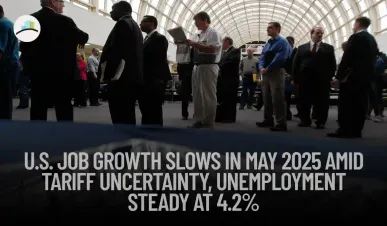
The U.S. labor market showed signs of slowing in May 2025, as employers added fewer jobs than expected, reflecting business caution amid ongoing tariff and policy uncertainties. While the unemployment rate held steady at 4.2 percent, the lowest since 2023, overall hiring momentum has cooled significantly.
May Jobs Report: A Soft Landing in Progress?
According to early estimates, U.S. nonfarm payrolls increased by approximately 130,000 in May — a decline from April’s 177,000 and below the three-month average of 155,000. This suggests that companies are easing their hiring plans without resorting to widespread layoffs.
The unemployment rate remained at 4.2 percent, unchanged for the third consecutive month. Average hourly earnings rose 0.3 percent month-over-month, pushing annual wage growth to 3.7 percent, a sign that while job creation is slowing, labor demand is still keeping wages afloat.
Key Drivers of the Slowdown
Several macroeconomic and policy factors have contributed to the slowdown:
-
Tariff tensions: heightened duties on Chinese goods and raw materials have squeezed margins for manufacturers and construction firms.
-
Immigration and policy uncertainty: shifting visa rules and legal actions related to federal workforce management have left businesses wary of making staffing changes.
-
Cautious optimism: many companies are in a “wait-and-see” mode, avoiding both hiring sprees and layoffs as they gauge Fed policy, inflation, and demand.
Also Read:
Sector Trends: Healthcare Steady, Construction Weak
Not all sectors were equally affected:
-
Healthcare and social assistance continued to add jobs, reflecting ongoing demand.
-
Manufacturing and construction posted weak numbers due to high input costs tied to import tariffs.
-
Professional services hiring slowed, especially in consulting and finance.
Economists note that although hiring is down, layoff rates remain historically low, signaling a soft landing rather than a sharp correction.
🇺🇸Trump’s tariffs never brought back industrial jobs. Why?
— Marie (@LMarimarie) June 6, 2025
➤ It’s not factories we lack,it’s workers.
➤ 2.1 million manufacturing jobs could go unfilled by 2030.
➤Tariff volatility freezes investment and hiring.
✅ The real battle is for human capital.https://t.co/ehysNuMKFI
What the Fed May Do Next
The Federal Reserve is expected to hold interest rates steady in its June meeting, as it continues to weigh signs of cooling inflation against the backdrop of slower job growth.
Some economists predict the first rate cut could come in the fourth quarter of 2025 if hiring continues to decelerate and inflation remains under control. A rate cut could offer support to both labor markets and consumer sentiment heading into 2026.
Labor Market Outlook: Still Resilient, But Vulnerable
While the U.S. labor market remains more resilient than other major economies, the signs of moderation are clear:
-
Wage growth is slowing but steady.
-
Participation rates are stable, but new entrants to the workforce have declined slightly.
-
Immigration’s contribution to labor growth has been modestly revised downward after recent court rulings.
With geopolitical uncertainty and fiscal policy debates heating up, economists warn that business confidence and hiring could remain muted in the coming months.
Source
Reuters – Slow US job growth anticipated in May; unemployment rate seen steady



