
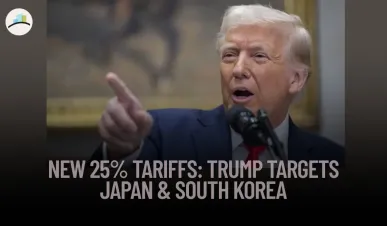
In a major escalation of his protectionist economic policies, former U.S. President Donald Trump has announced that a 25% reciprocal tariff will be levied on a broad range of imports from Japan and South Korea starting August 1, 2025. This development represents a dramatic reassertion of Trump’s nationalist trade doctrine, reviving the tariff-first stance that defined much of his first term in office.
Trump communicated the decision via official letters published on Truth Social, signaling his intent to penalize what he perceives as long-standing trade imbalances with key U.S. allies in East Asia. According to Trump, these tariffs are designed to rebalance trade relationships he considers unfair and damaging to American manufacturing.
The 25% tariffs are not blanket measures on all imports but are aimed primarily at sectors with high trade deficits or strategic vulnerabilities. Though no detailed tariff schedule has yet been published, the move is expected to heavily impact the automotive, electronics, and semiconductor supply chains—sectors where Japan and South Korea are key global players.
Trump framed the move as a “reciprocal tariff policy,” meaning that if these countries continue to impose tariffs on U.S. goods, the United States will match them “dollar for dollar.” While the language remains ambiguous, the threat of escalation is clearly intended to bring these nations to the negotiating table before the August 1 deadline.
More Articles:
Strategic Motivations Behind the Tariff Play
The new tariffs are framed as part of a broader campaign to tackle what Trump calls a national economic threat: the persistent U.S. trade deficit with Japan and South Korea. In 2024, the United States recorded trade deficits of $69 billion with Japan and $66 billion with South Korea—levels Trump argues are evidence of systemic unfairness in trade relationships.
This announcement is also strategically timed to strengthen Trump’s position ahead of the upcoming election cycle. The narrative of “bringing jobs back to America” continues to resonate with large sections of the American working class, particularly in manufacturing-heavy swing states like Michigan, Pennsylvania, and Ohio.
From a diplomatic standpoint, this move may prove more complex. Both Japan and South Korea are central to U.S. alliances in Asia, not only economically but also in terms of military and regional security cooperation. Introducing tariffs on these allies risks weakening diplomatic unity at a time of increased geopolitical tension in the Indo-Pacific.
Global Market and Economic Reactions
Financial markets responded with notable volatility following Trump’s announcement. The Japanese yen fell to a two-week low, and the South Korean won also dipped, reflecting investor concerns about export demand and rising geopolitical risks. U.S. futures traded cautiously, with sectoral indices in automotive and semiconductors experiencing early declines.
Tokyo and Seoul reacted with measured concern. Japanese officials expressed “deep regret” and called for immediate bilateral talks, while South Korea’s Ministry of Trade convened an emergency economic task force to assess possible retaliatory measures.
Economists and trade analysts warn that while the short-term impact may be manageable, prolonged uncertainty could disrupt global supply chains, particularly in industries heavily dependent on components and raw materials from Japan and Korea. The semiconductor ecosystem—already under strain from prior global disruptions—could be particularly vulnerable.
🚨 Trump Issues New Tariff Rates, Still Open to Negotiations
— Meow Meow News (@MeowMeowMews) July 8, 2025
President Donald Trump unveiled a wave of letters again threatening key trading partners with high tariff rates even as he delayed the increased duties until Aug. 1 and suggested that he was still open to negotiations.… pic.twitter.com/mtq9BxfFaY
Procapitas Insights: What the Headlines Don’t Say
-
Leverage, Not Finality
While the tariffs are scheduled to take effect on August 1, the use of the term “reciprocal” and the deadline-based structure suggest that Trump is positioning this more as a negotiating tactic than a finalized policy. Both Japan and South Korea may attempt to renegotiate market access or announce new investment deals in the U.S. to avoid the tariffs. -
High-Tech Supply Chain Risks
This is not a repeat of steel or aluminum tariffs from 2018. Today’s targeted industries—particularly semiconductors and EV batteries—are deeply integrated across borders. Tariffs could backfire by raising costs for American companies that rely on precision components from Asia. -
Geopolitical Ripple Effect
Imposing tariffs on key allies may weaken multilateral initiatives like the Indo-Pacific Economic Framework and disrupt trilateral defense cooperation against threats from North Korea and China. In an era of heightened China-U.S. tension, alienating regional allies could have long-term strategic consequences. -
Election Strategy Cloaked in Policy
Trump’s announcement ties trade tariffs to domestic funding initiatives. He suggested that revenue from tariffs will finance tax cuts and infrastructure projects. This messaging is aimed squarely at his political base, reinforcing the idea that foreign countries are footing the bill for American prosperity. -
Mixed Messaging in Global Trade
At the same time that these tariffs are being threatened, Trump continues to pursue trade deals with other regions, including BRICS-aligned nations. This dual approach—punishing some allies while engaging others—creates ambiguity in U.S. trade policy and adds to global uncertainty.
Disclaimer:
This article is intended for informational purposes only and does not constitute investment advice. Procapitas does not provide personalized financial recommendations. Always consult a licensed financial advisor before making investment decisions. Information is based on publicly available sources as of June 2025 and Procapitas’ independent research and analysis.



